Phase3D wins US Air Force contract to adapt Fringe Inspection for ceramic matrix composites
Phase3D, located in Chicago, Illinois, USA, has announced a new contract award from the Department of the Air Force. The award will fund the extension of Phase3D’s Fringe Inspection platform, already deployed across aerospace, defence, and industrial manufacturing, into a new materials class: ceramic matrix composites (CMCs), which are being developed for applications in next-generation propulsion, hypersonic and thermal-protection systems.
According to Phase3D, the Department of the Air Force is expanding its use of advanced manufacturing to support agile sustainment, distributed production, and mission readiness, but the lack of deployable, real-time quality assurance tools remains a persistent barrier. That gap is especially acute for CMCs, which offer exceptional thermal resistance, strength-to-weight ratio, and oxidation resistance compared with traditional metal alloys, making them attractive for turbine engines, hypersonic vehicles, and thermal-protection systems. Despite this, Phase3D states that CMCs remain underutilised across Air Force sustainment and production environments because conventional non-destructive evaluation (NDE) methods, developed largely for metals and polymer composites, cannot reliably detect the matrix cracking, fibre pull-out, porosity, and delamination that can occur throughout CMC fabrication.

Phase3D identified the most immediate end users as the Air Force Life Cycle Management Center’s Propulsion Directorate (AFLCMC/ROD) and Rapid Sustainment Office (AFLCMC/RSO), along with the Air Force Research Laboratory’s Materials and Manufacturing Directorate (AFRL/RX). The company claims that all three organisations are actively transitioning advanced materials into operational systems and require inspection tools that can be deployed at depots, OEM facilities, and research centres.
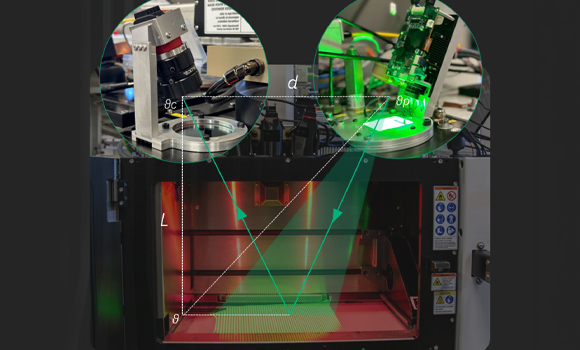
Fringe Inspection uses structured-light scanning to generate calibrated, repeatable surface heightmaps during production, an approach Phase3D has spent years validating on metal Additive Manufacturing with partners including NASA, the US Navy, Air Force sustainment depots and the Air Force Research Laboratory. This programme adapts that same core technology to CMC manufacturing, where defects, Phase3D states, can be introduced at nearly every stage, from tape fabrication and ply stacking through autoclave consolidation, pyrolysis, melt infiltration, and final machining.
Phase3D will develop material-specific calibration routines, anomaly-classification models, and validation protocols that allow Fringe Inspection to identify surface deformation and defect signatures as CMC parts are manufactured, rather than waiting for post-process CT scanning or destructive sectioning.
Dr Niall O’Dowd, Founder and CEO of Phase3D, shared, “Fringe Inspection was built to answer one question in real time: is the part you are building the part you designed? We’ve spent years proving that out on metal parts for NASA, the Air Force, and leading aerospace primes. This programme lets us ask the same question of a completely different material system, one the Air Force is counting on for the next generation of propulsion and thermal protection, and where the cost of finding a defect after the part is finished is even higher than it is in metal.”
This Phase I effort will evaluate the feasibility of adapting Fringe Inspection to CMC production environments and identify the stakeholders and end users best positioned to carry the technology forward. Phase3D has already engaged Air Force stakeholders, including AFRL, Oklahoma City Air Logistics Complex (OC-ALC), and Ellsworth Air Force Base through prior work, and plans to deepen those relationships over the course of the programme.

Andrew Holliday, Applications Engineering Manager at Phase3D, stated, “Ceramic matrix composites are notoriously hard to qualify because so much can go wrong across so many stages, from tape fabrication all the way through infiltration and final machining. The industry has been trying to solve that with post-process CT scans and destructive testing, the same approach that used to hold back metal Additive Manufacturing. Real-time, layer-by-layer visibility is exactly what this material needs, and it is exactly what Fringe Inspection already does.”
Phase3D states that industry forecasts estimate the global CMC market will exceed $13.3 billion by 2029, with the cost of poor quality across that market estimated at $1.6 billion to $2.4 billion annually, driven largely by defects discovered late in production. By moving inspection earlier into the manufacturing process, Phase3D expects Fringe Inspection to reduce rework and scrap while accelerating qualification timelines, which the company states would mirror results from the platform’s existing metal AM programmes with NASA, the US Navy, the Air Force, the Department of Energy, and companies in the automotive and aerospace sectors. Phase3D anticipates that successful completion of this effort will position the company to serve a growing market for advanced materials inspection, with applications extending beyond defence into commercial aerospace, energy, and industrial ceramics.