NODiVEC demonstrates rapid distortion prediction for aerospace component
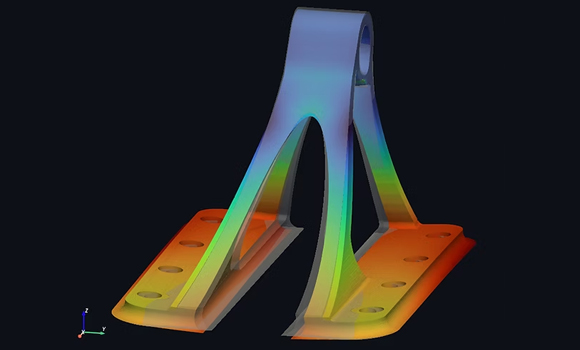
NODiVEC LLC, Columbia, South Carolina, USA, reports that its Rheona simulation platform completed an analysis of a Ti-6Al-4V aerospace structural hinge in 9.3 minutes, compared with more than three hours and 15 minutes reported for an earlier multi-scale finite element analysis (FEA) of the same component.
The case study examined the prediction of residual stress and resulting distortion in components produced using Laser Beam Powder Bed Fusion (PBF-LB) Additive Manufacturing.

Residual stresses generated by thermal gradients during the metal AM build process can cause components to deform when separated from the build plate, potentially affecting dimensional accuracy. Predictive simulation enables engineers to assess these effects before manufacturing and make adjustments to part orientation, support structures or component geometry.
For the benchmark, a titanium aerospace structural hinge was represented using a voxelised mesh containing 127,454 eight-node hexahedral (HEX8) elements. The simulation comprised 96 layer activation steps followed by a springback analysis, using an Intel PARDISO multithreaded direct solver.
The Rheona Solver completed the analysis in 558.3 seconds (9.3 minutes), including 496.3 seconds for the build phase, 13.6 seconds for springback analysis and 48.3 seconds for exporting the results. According to the analysis, a conventional multi-scale FEA simulation of the same component previously required more than three hours and 15 minutes.
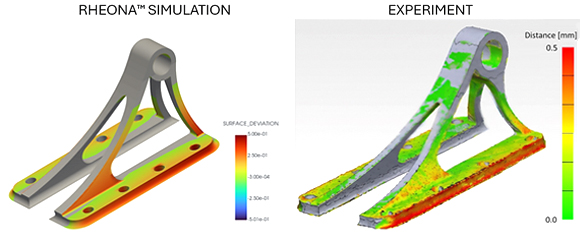
The case study also compared the predicted displacement with an optical 3D scan of the manufactured component following its removal from the build plate using wire electrical discharge machining (EDM).
The results reportedly showed similar distortion patterns, with both the simulation and physical scan identifying concentrations of deformation along the flared mounting rails and peak deflections of approximately 0.50 mm. The simulation also predicted inward bowing of the vertical hinge ribs and upward distortion of the outer edges resulting from residual stress release.
According to the developer, reduced simulation times could allow engineers to evaluate multiple build orientations and support configurations before committing to production. This could help identify potential recoater collisions, minimise distortion of critical features and reduce the need for physical trial builds.
The software’s predicted displacement fields could also be used to apply geometric pre-compensation, in which the original CAD geometry is adjusted to account for anticipated deformation during manufacturing and subsequent removal from the build plate.
The developer sees potential applications for the software in aerospace, medical and tooling production, where dimensional accuracy and process repeatability are important considerations.