CHIPART converts aerospace titanium machining chips into powder
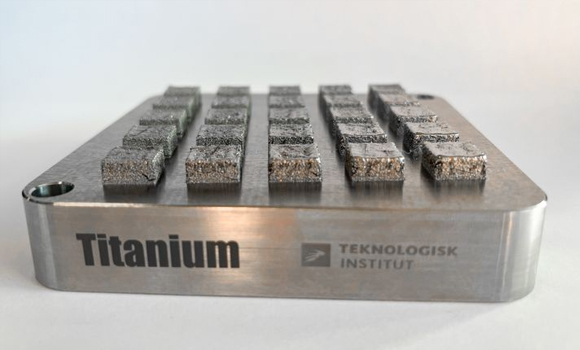
The Danish Technological Institute, together with project partners IDONIAL of Spain and CRM Group of Belgium, is presenting the results of the recently completed CHIPART (Chips to Parts: Circularity of Titanium Scrap from Machining to Additive Manufacturing) project to the European Defence Agency (EDA) in Liège.
Supported by the EDA, the twelve-month proof-of-concept project investigated the potential to reduce the environmental impact and costs associated with titanium powder production. The analysis also indicated that total manufacturing costs, including machine time and post-processing, could be lower than when using only virgin titanium powder. According to the researchers, the project has demonstrated that titanium machining chips from the aerospace industry can be converted into metal powder suitable for Additive Manufacturing without the need for remelting.

“By converting machining chips directly into metal powder for Additive Manufacturing without remelting, we have shown that circularity in titanium manufacturing can provide environmental benefits and be economically viable on a large scale,” stated Magdalena Müller, materials specialist at the Danish Technological Institute.
The recycled titanium powder was evaluated using two metal AM processes: Laser Beam Powder Bed Fusion (PBF-LB) and Directed Energy Deposition (DED).
“We found that mixing recycled powder with new titanium powder produced the best results, and that controlling the oxygen level in the machine was the decisive factor for print quality,” Müller explained.
Following optimisation of the process parameters, the project achieved a reported material density of at least 98% in the manufactured parts, meeting its target.

The Danish Technological Institute also developed an economic model based on a demonstrator component to assess the potential costs of using recycled powder. Although recycling costs were higher at laboratory scale, the model indicated that industrial-scale production could deliver recycled titanium powder at a significantly lower cost than virgin powder.
The analysis also suggested that overall manufacturing costs could be reduced when machine time and post-processing were taken into account, compared with manufacturing using only virgin titanium powder.
CHIPART ran from October 2025 to September 2026 under the Incubation Forum for Circular Economy in European Defence (IF CEED). The project involved additional industrial partners from the aerospace and defence sectors, which supplied titanium machining chips and a reference demonstrator component.
The project builds on the earlier VARETIT initiative, which also involved the Danish Technological Institute and investigated recycling titanium scrap into powder for Additive Manufacturing.