ASTRO America and Northrop Grumman target faster Gray Wolf missile production with AM
The Applied Science & Technology Research Organization of America (ASTRO America) has announced a Cooperative Research and Development Agreement (CRADA) with Northrop Grumman, Florida State University’s Institute for Strategic Partnerships, Innovation, Research, and Education (FSU InSPIRE), and the Air Force Research Laboratory (AFRL) Air Warfare Directorate’s Mission Effects Division. The collaboration will investigate manufacturing processes intended to reduce the cost and production time of subsonic munitions.
Under the Design for Affordable and Rapid Throughput (DART) initiative, the partners will assess, develop and implement manufacturing processes aimed at reducing production and qualification costs for adaptable subsonic missile bodies and components. These include Additive Manufacturing technologies such as additive solid-state deposition and Powder Bed Fusion (PBF), alongside casting and subtractive manufacturing methods.

The work will take place at a new production laboratory near Eglin Air Force Base in Northwest Florida. ASTRO America will collaborate with FSU InSPIRE on materials and subsystem evaluation, including mechanical, thermal and aero testing.
“ASTRO would not have brought this partnership to Northwest Florida without the steadfast support of Florida State University and the transformative investment from Triumph Gulf Coast in InSPIRE,” stated Dr Abdalla R Nassar, Vice President and General Manager of ASTRO South.
“Industry today is under extreme pressure to produce better products faster while de-risking innovation,” added Drew Allen, Executive Director of FSU InSPIRE.
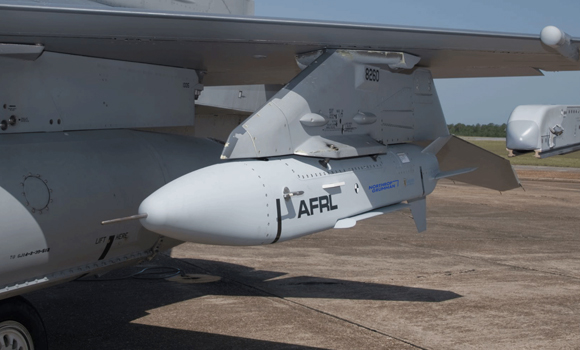
The DART initiative will apply these manufacturing processes to the Gray Wolf missile system, developed through collaboration between Northrop Grumman and the AFRL Munitions Directorate, now the AFRL Air Warfare Directorate. The missile system was developed with the aim of minimising per-unit costs and features an open architecture designed to support a range of payloads and carriage on multiple US Air Force and US Navy platforms.
The partners will investigate how the manufacturing processes can support higher-throughput production of Gray Wolf components, with the findings potentially informing manufacturing approaches for other munition systems.