ESA reaches fifth ISS metal Additive Manufacturing milestone
The European Space Agency (ESA) has reported the latest progress of its Metal 3D Printer Technology Demonstrator aboard the International Space Station (ISS), where the machine has now produced its fifth metal sample as part of an ongoing programme to evaluate Additive Manufacturing in space.
ESA states that Additive Manufacturing could play a key role in supporting future human exploration missions, where carrying large inventories of spare parts is impractical and resupply may be impossible. As astronauts venture further from Earth, the ability to manufacture metal or polymer replacement parts, tools and other components on demand could help improve crew autonomy and reduce reliance on supply missions.
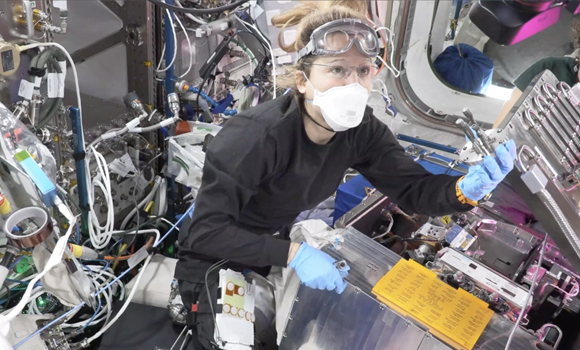
Launched to the ISS in 2024 as the first metal Additive Manufacturing machine to operate in orbit, the demonstrator recently produced its fifth sample, which was retrieved by ESA astronaut Sophie Adenot during the εpsilon mission.
According to ESA, six cargo missions have departed the ISS since the beginning of 2026 after delivering supplies. While the station, orbiting approximately 400 km above Earth, remains within reach of regular resupply missions, the agency believes in-orbit manufacturing will become increasingly important for future deep-space exploration.
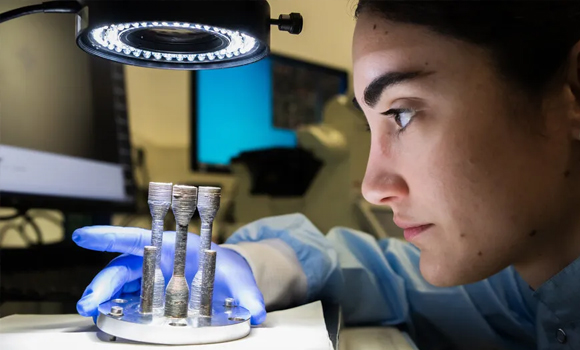
The latest sample will contribute to ESA’s ongoing assessment of the printing process, helping engineers better understand the capabilities of metal Additive Manufacturing in microgravity and further develop operational procedures for both astronauts and ground teams.
“3D printers are far from being simple gadgets and I’m delighted to have worked on this European technology demonstration for the future of human spaceflight,” stated Adenot. “Congratulations to everyone involved and thank you to the CADMOS User Support Centre teams who guided me throughout the process!”
ESA added that three previously manufactured samples have already been returned to Earth for analysis at ESTEC, the agency’s technical centre in the Netherlands, and the Technical University of Denmark (DTU). Researchers have compared the macro- and microstructural characteristics of the space-produced components with reference samples manufactured on Earth using the same Additive Manufacturing machine. The agency stated that the results of this analysis will be published in the coming weeks.
Each sample has been designed to evaluate a different aspect of the machine’s performance, helping ESA assess the reliability and operational capabilities of metal Additive Manufacturing in orbit.
“With a better understanding of the printer’s capabilities, limitations and operations – both in orbit and on the ground – as well as the quality of parts produced in a crewed space environment, ESA is now well-positioned to take the next step towards in-orbit metal 3D printing,” explained ESA Technical Officer Rob Postema.
As part of the latest activity, Adenot also prepared the AM machine for its next build by installing a new substrate, or baseplate, carrying a partially completed component. ESA explained that Additive Manufacturing had previously been interrupted following an anomaly, and the forthcoming operation will test a recovery procedure intended to resume production from the point at which it stopped.
The fifth sample has since been returned to Earth aboard the CRS SpX-34 spacecraft and will undergo further evaluation at the German Aerospace Center (DLR) and ESTEC.