RMIT uses infrared data and machine learning to assess DED builds
NewsResearch
September 28, 2026
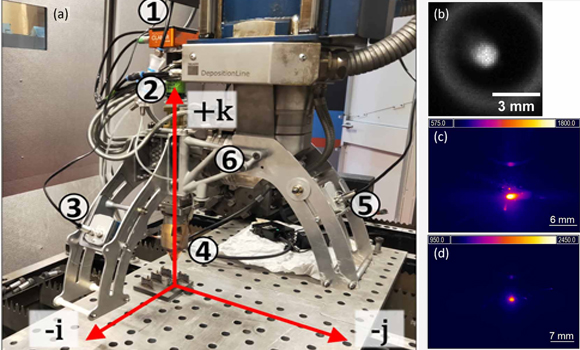
Experimental setup and example IR images from the manufacture of a thin-wall sample. a) Installation of IR cameras on TRUMPF deposition head with machine coordinate axes superimposed. The primary components are numbered: 1) CLAMIR camera, 2) Coaxial mounting port for CLAMIR camera, 3) Optris PI 05 M thermal camera, 4) Coaxial powder nozzle for DED-LB/M, 5) Optris PI 1 M thermal camera, 6) Stabilisation brace for side-mounted bracket. b) Greyscale image from CLAMIR. c) Thermographic image from Optris PI 1 M. d) Thermographic image from Optris PI 05 M (Courtesy Journal of Physics: Photonics)

Researchers at RMIT University, Melbourne, Australia, have published a study in Journal of Physics: Photonics investigating the use of multi-axis infrared process monitoring and machine learning to assess build conditions during Laser-Beam Directed Energy Deposition (DED-LB) Additive Manufacturing.

The research uses time-sequenced infrared process-monitoring data as input for long short-term memory (LSTM) neural networks. Rather than assessing individual measurements in isolation, the approach uses temporal information contained in the continuous DED process.
Sinter-based Additive Manufacturing: Beyond the hype, towards industrial success

The researchers investigated both single-source and multi-source infrared data. According to the paper, the multi-source LSTM models were able to predict build conditions including bulging, depression, porosity and over- or under-building. The study reports F1 scores exceeding 0.95, with inference times of 2 ms for each 0.5 s observation window.

The authors state that the combination of in situ monitoring and contextual machine learning could enable rapid interpretation of process-monitoring data both offline and in-line. The approach may also support the future development of feedback control during metal Additive Manufacturing.
The research builds on previous work involving the RMIT Centre for Additive Manufacturing and CSIRO Manufacturing into multi-axis infrared monitoring for DED, including the detection of process-induced porosity and other structural features during deposition.

‘Multi-axis infrared process monitoring with contextual machine learning for inspecting build-condition in laser directed energy deposition’ is available here.
rmit.edu.au

GET THIS ISSUE:  PDF  |  VIEW ONLINE  |  BUYER’S GUIDE
NewsResearch
September 28, 2026

TRUSTED CONTENT. TARGETED AUDIENCE

Advertise with Metal AM and access a global base of 50,000+ AM professionals.

Contact Jon Craxford: [email protected]

Request a Media Pack
  • AM machines
  • Process monitoring & calibration
  • Heat treatment & sintering
  • HIP systems & services
  • Pre- & post-processing technology
  • Powders, powder production and analysis
  • Part manufacturers
  • Consulting, training & market data

Don’t miss a thing – register for our newsletter

Don't miss any new issue of Metal AM magazine, and get the latest industry news. Sign up to our twice weekly newsletter.

Register now

Join 40,000+ other AM professionals – follow us online

About Metal Additive Manufacturing magazine

Metal AM magazine, published quarterly in digital and print formats, is read by a rapidly expanding international audience.

Our audience includes component manufacturers, end-users, materials and equipment suppliers, analysts, researchers and more.

In addition to providing extensive industry news coverage, Metal AM magazine is known for exclusive, in-depth articles and technical reports.

Our focus is the entire metal AM process from design to application.

Each issue is available as an easy-to-navigate digital edition and a high-quality print publication.

Discover our magazine archive…

The free to access Metal Additive Manufacturing magazine archive offers unparalleled insight into the world of metal Additive Manufacturing from a commercial and technological perspective through:

  • Reports on visits to leading metal AM part manufacturers and industry suppliers
  • Articles on technology and application trends
  • Information on materials developments
  • Reviews of key technical presentations from the international conference circuit
  • International industry news

All past issues are available to download as free PDFs or view in your browser.

Browse the archive

Share via
Copy link
Powered by Social Snap