Aalberts combines HIP and thermal processing for metal AM and Powder Metallurgy components
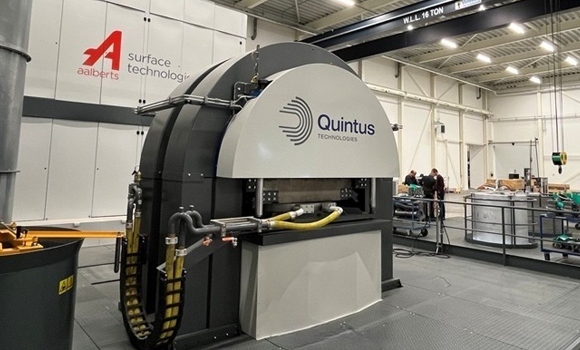
Aalberts Surface Technologies has expanded its offering for Powder Metallurgy and additively manufactured components, combining Hot Isostatic Pressing (HIP) with heat treatment, vacuum processing and other thermal processing technologies.
The company operates HIP facilities in Europe and North America and currently lists six HIP vessels across its network. These comprise two QIH232 systems in Eindhoven, the Netherlands, and four QIH122 systems located across Greenville, Windsor and Cleveland in the United States.
Aalberts uses HIP for the post-processing of additively manufactured components, as well as for the consolidation of Powder Metallurgy materials into fully dense components, processing of castings and diffusion bonding.
The process applies elevated temperature and isostatic gas pressure to components to reduce internal porosity and defects. Aalberts’ HIP systems can operate at temperatures of up to 1,250°C and pressures of up to 200 MPa (2,000 bar).
Alongside HIP, the company’s thermal processing capabilities include vacuum hardening, solution and precipitation hardening, stress relieving, annealing, nitriding and other heat treatment processes. By coordinating these processes across its facilities, Aalberts aims to enable components to move from HIP densification into subsequent thermal processing within the same supplier network.
This is particularly relevant to metal Additive Manufacturing, where HIP is commonly used to reduce process-induced internal porosity before subsequent heat treatment is used to develop the required microstructure and mechanical properties.
Aalberts lists nickel-base alloys, steels and tool steels, copper alloys, titanium and aluminium among the materials suitable for its HIP processes. Target industries include aerospace and defence, energy, medical, space and other industrial applications.
The company states that its wider network enables customers requiring multiple post-processing operations to coordinate these processes through a single organisation, rather than transferring components between independent HIP and heat treatment suppliers.