Patient-specific titanium implants aid chest reconstruction
Researchers from Morriston Hospital and Swansea University, Wales, UK, have published a study in npj Biomedical Innovations describing a digital-to-surgical workflow for reconstructing large chest wall defects using patient-specific titanium implants produced by Laser Beam Powder Bed Fusion (PBF-LB) Additive Manufacturing.
The single-centre study involved six consecutive adult patients requiring major chest wall resection. Eligible cases included resections involving three or more ribs and adjacent structures, combinations of ribs and hemi-sternum, or the sternum, cartilage, and ribs, where the resulting full-thickness skeletal defect was considered unsuitable for primary closure.

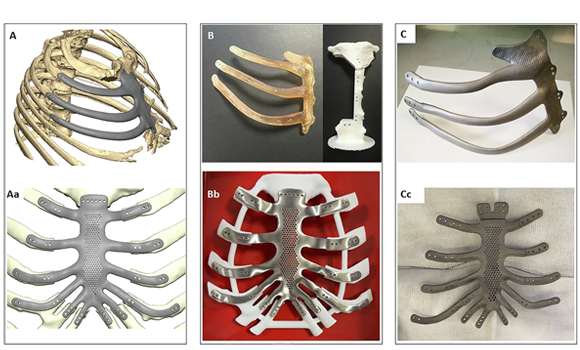
The workflow began with high-resolution, thin-slice CT imaging of 1 mm or less, supplied in Digital Imaging and Communications in Medicine (DICOM) format. The data were segmented using Mimics Medical software to generate patient-specific 3D models of the chest wall and tumour, allowing the surgical team to assess tumour geometry and its relationship with surrounding thoracic structures.
Virtual surgical planning was then carried out using Geomagic Freeform Plus. The segmented models were digitally edited to simulate tumour excision, define resection margins and design an implant matching the anatomical shape, size, and contour of the planned resection.
Following virtual validation, the implant designs were physically assessed using stereolithography (SLA) prototypes. The final patient-specific implants were then manufactured in medical-grade Ti-6Al-4V ELI Grade 23 titanium alloy using PBF-LB and sterilised before surgery.

In all six cases, the digitally planned resections and reconstructions were completed without intraoperative modification. The implants were reported to provide an accurate anatomical fit and secure fixation, with satisfactory restoration of chest wall anatomy.
Follow-up ranged from five months to five years, during which no implant failures or implant-related complications were reported. Two patients who underwent reconstruction for palliative purposes subsequently died following progression of their underlying disease.
‘An integrated digital-to-surgical framework for patient-specific chest wall resection and reconstruction using 3D-printed titanium implants: proof-of-concept study’ is available here.