Cailabs develops compact coaxial wire DED head
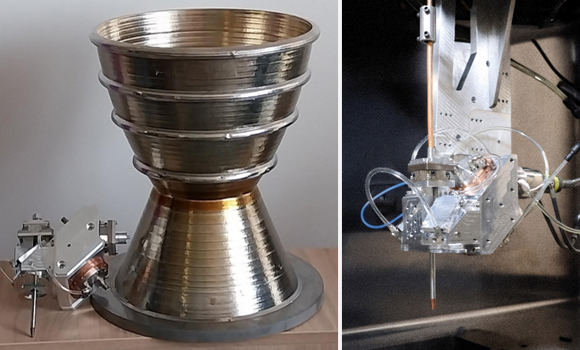
Cailabs, based in Rennes, France, has developed a compact optical head for wire-based Directed Energy Deposition (DED) Additive Manufacturing that positions the feed wire coaxially within a ring-shaped laser beam. The CANUNDA-DED head uses a patent-pending mirror concept incorporating three optical elements and is designed for integration with robots, CNC machines and hybrid manufacturing machines.
In conventional wire-based DED, the wire is typically fed into the processing zone from the side, meaning its orientation relative to the laser and melt pool changes with the direction of travel. Cailabs’ coaxial approach positions the wire on the optical axis, surrounded by a symmetrical ring of laser radiation, maintaining substantially the same geometry regardless of travel direction. This is intended to simplify toolpath planning and improve process consistency when depositing complex geometries.

Coaxial wire and laser arrangement
The optical system must collimate the incoming laser beam, transform it into a ring, provide an opening for the wire and focus the radiation around the centrally fed wire.
The CANUNDA-DED architecture performs these functions using three mirrors. The first collimates and divides the beam, while a further pair forms two half-rings and focuses them for recombination around the wire. Each optical path requires two reflections.
The head is specified for laser powers of up to 12 kW. Cailabs states that standard configurations accommodate wire diameters from 0.8–1.6 mm, with other diameters available on request. Larger wires and higher laser powers can support higher deposition rates, while smaller wire diameters can be used for finer features.
Deposition trials
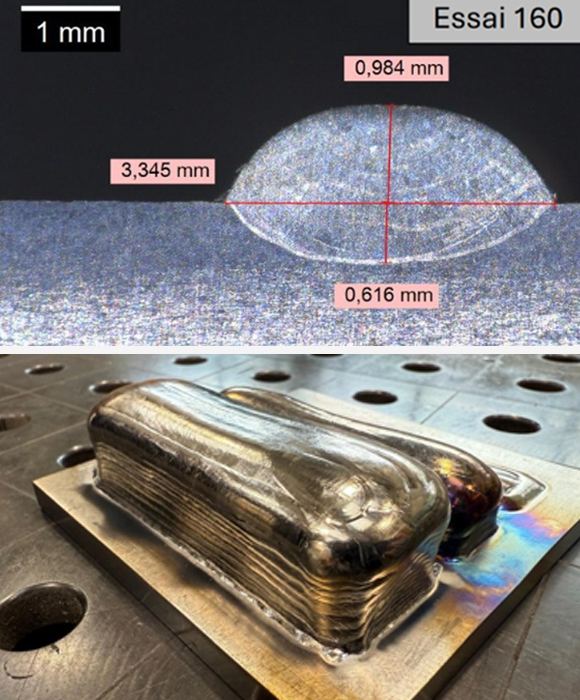
Cailabs demonstrated the concept in 2025 before carrying out high-power deposition trials with titanium and steel. Initial deposition experiments were also carried out with a beam that was not yet perfectly symmetrical. Successful deposition was nevertheless achieved, which Cailabs regards as an indication of process tolerance.
One reported test achieved a deposition rate of 0.9 kg/h at a travel speed of 3 m/min, with trials conducted at laser powers of 3.75 kW and 4 kW. Cailabs also reported that macrographic sections of the deposits showed compliant quality.
TA6V titanium (Ti-6Al-4V, according to Cailabs) was deposited at 4 kW and a travel speed of 0.6 m/min. The development programme also investigated steel deposition and the influence of beam ellipticity on the interaction between the wire and melt pool.
More recent trials have focused on 316L stainless steel. Reported operating points included a deposition rate of 1 kg/h at 3 kW and a travel speed of 0.9 m/min, and 1.1 kg/h at 2.7 kW and 1 m/min. According to Cailabs, the trials also highlighted the need to balance laser power against wire stability, weld homogeneity, lack of fusion and fume generation.
Redesign for machine integration
Following the proof of concept, Cailabs redesigned the system during 2026 with machine integration in mind. The original demonstrator weighed 7.5 kg, excluding the wire feeder and sensors. The subsequent prototype weighs less than 5 kg and measures less than 200 × 150 × 150 mm, while including provisions for process-monitoring equipment. The redesigned optics provide a depth of field of approximately 5 mm.
The reduced size and mass are intended to facilitate integration with smaller robots or collaborative robots, as well as existing CNC machine tools.
Provision has also been made for process monitoring, including pyrometry, process imaging, temperature monitoring and contamination detection. Additional mounting points can accommodate equipment such as crossjets and thermal cameras.
The wire delivery system is designed as a modular component, with push-pull configurations available for systems using heVavy wire drums or remotely located coils.
The CANUNDA-DED head is now available for application development.