Velo3D cuts AM simulation engineering time with PanX
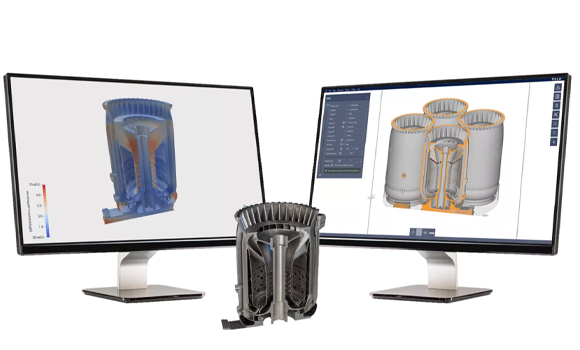
Velo3D Inc, Fremont, California, USA, has reported that eleven of twelve builds were completed successfully on the first attempt in a customer programme following the integration of PanX simulation technology from PanOptimization, State College, Pennsylvania, with its proprietary calibration and Additive Manufacturing processes. The company also reported improvements in dimensional accuracy and engineering efficiency.
In a copper-nickel customer programme using Velo3D’s large-format, eight-laser Sapphire XC Laser Beam Powder Bed Fusion (PBF-LB) machine, the company’s applications engineering team simulated 12 builds representing 33 customer geometries and 1,756 print hours. Eleven builds were completed successfully on the first attempt. The remaining build experienced a support structure failure but was completed on the second attempt following adjustments informed by the initial results.

The findings were presented at ASTM International’s Conference on Advanced Manufacturing (ICAM) 2026 in Orlando by Daniel Driscoll, Senior Applications Engineer at Velo3D, during a joint technical session with PanOptimization.
“I have been in AM for 15 years. When I started out, ‘first-time right’ was really just a marketing buzz phrase. To see that it is now actually achievable through use of simulation is very satisfying. It is fun watching what a capable and forward-thinking organisation like Velo can achieve with a powerful tool like PanX,” said Erik Denlinger, co-founder and Chief Engineer at PanOptimization.
Arun Jeldi, Chief Executive Officer of Velo3D, added, “Customers need more than the ability to print a complex part. They need a manufacturing process they can plan around. By combining simulation with our calibration methods and production expertise, we’re improving our ability to identify potential issues before a build begins. These results demonstrate meaningful progress toward more predictable and efficient production of complex metal components.”
Integrating simulation into production
Velo3D integrated PanX into its existing build preparation workflow, allowing CAD geometry, support structures and process definitions to be transferred without extensive manual reconstruction.
According to the company, this reduced hands-on engineering time for simulation and distortion pre-compensation from 4–40 hours per build to less than one hour, making simulation more practical for routine production preparation.
Velo3D also used its calibration process, incorporating production data and in situ thermal measurements to refine simulation inputs, including powder conductivity, process efficiency and thermal boundary conditions. The company reported improved agreement between simulated and measured manufacturing behaviour.

Demonstrating dimensional accuracy
In a separate demonstration involving a microturbine engine core measuring approximately 330 × 356 × 432 mm (13 × 14 × 17 in), PanX simulations conducted without advanced calibration or trial builds closely tracked measured distortion trends and predicted peak distortion to within approximately 125 µm (0.005 in).
Following one round of simulation-based compensation, peak dimensional deviation decreased from +2.0/−1.9 mm to +0.7/−0.6 mm, representing a reported 65% reduction. The resulting component met its specified dimensional tolerances.
According to Velo3D, these results suggest that combining predictive simulation with manufacturing data and process calibration could reduce the need for physical build iterations, potentially saving machine capacity, materials and production time. This is particularly relevant to large-format metal Additive Manufacturing, where complex geometries and extended build times can increase the consequences of unsuccessful builds.
Discover more about PanX in our exclusive article:
PanOptimization’s PanX: Scalable simulation and optimisation for large-format metal AM