3MF Consortium launches machine-independent Toolpath Extension for PBF-LB
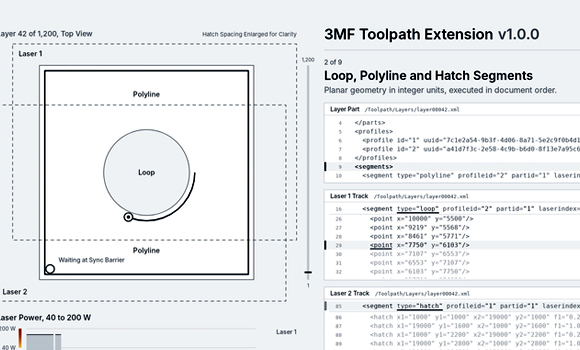
The 3MF Consortium, headquartered in San Francisco, California, USA, has released the 3MF Toolpath Extension v1.0.0, providing an open, machine-independent format for toolpath data in Additive Manufacturing.
Developed primarily for Laser Beam Powder Bed Fusion (PBF-LB), the extension also supports other layer-based laser processes and multi-axis toolpaths, including those used in Directed Energy Deposition (DED).
Industrial PBF-LB build files are typically generated in proprietary formats specific to individual machine manufacturers. According to the consortium, this can restrict software compatibility, complicate traceability and make it more difficult to use common inspection and simulation tools.

The extension includes capabilities for:
- Process parameters: Toolpath profiles defining laser power, marking and jump speeds, focus offset and spot radius, with support for additional machine-specific parameters.
- Parameter modulation: Variation of laser power and other parameters along individual scan vectors, within defined operating limits.
- Timing: Microsecond-precision wait times before and after individual segments.
- Multi-laser builds: Support for multiple lasers, including scan fields and synchronisation barriers.
- Geometry traceability: Linking individual toolpath segments to their originating build items.
- Scalable data handling: Per-layer packaging to enable random access and streaming of large builds.
Future development is expected to include volumetric and field-driven parameter assignment.
“I see the 3MF Toolpath Extension doing for LPBF what G-code did for CNC. A non-proprietary toolpath format for LPBF will enable inspection to begin before the build, because digital inspection tools will no longer need to be built for machine-specific formats. Removing the file format barrier between slicer and machine will also unlock innovation by letting users leverage rapidly evolving toolpathing solutions. I believe this will be the single most impactful development in LPBF over the next ten years, if machine makers rapidly and fully adopt the format and all of its advanced capabilities,” commented Hunter Taylor, CTO of Tailored Alloys.

Alexander Oster, Technical Director of the 3MF Consortium, added: “With the rapid growth of industrial LPBF, the need for a machine-independent way to represent laser build data has become increasingly clear. The 3MF Toolpath Extension brings together years of collaboration across machine builders, software developers, and research institutions.”
Oster continued: “It provides a standardised way to describe exactly what the laser does, from power, speed, focus, and beam shape to microsecond timing and multi-laser synchronisation, while keeping the toolpath linked to the original part geometry. This gives the industry a common, open representation for state-of-the-art laser processing without being tied to a proprietary ecosystem.”
The 3MF Consortium was formed following meetings involving Microsoft, HP, Netfabb (later acquired by Autodesk) and Dassault SolidWorks, which had been independently developing formats for 3D data optimised for Additive Manufacturing.
As reported by Metal AM last year, the consortium’s 3D Manufacturing Format (3MF) was standardised under ISO/IEC 25422:2025. The consortium intends to add the Toolpath Extension to the ISO/IEC 25422 specification suite.