AMCM integrates PanX simulation software with EOSPRINT
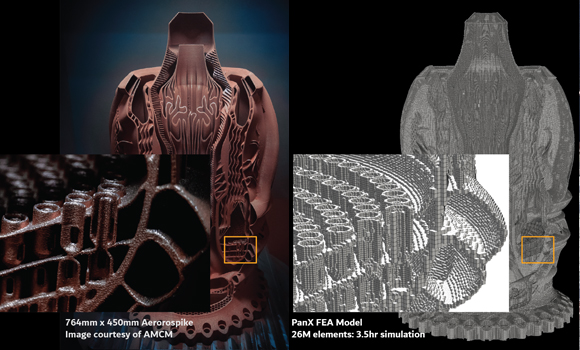
AMCM GmbH, based in Starnberg, Germany, has integrated PanX thermomechanical simulation software from State College, Pennsylvania-based PanOptimization with EOSPRINT, enabling metal Additive Manufacturing builds to be simulated and optimised as part of the build-preparation workflow.
The integration is intended to help users identify thermal hotspots, distortion and other thermally induced problems before production begins, particularly when manufacturing large and complex components.
“Especially for the large and complex applications our customers manufacture on the AMCM M 4K and M 8K, thermomechanical simulation is a key tool to counteract overheating and thermally induced distortion,” stated Tobias Petzinger, Application Specialist at AMCM GmbH. “By integrating PanX directly into EOSPRINT, we can seamlessly optimise thermal management and build strategies before production begins.”
PanX reads an openjz file from EOSPRINT and extracts build information including component geometries, build-plate layout and processing parameters. Additional information required for the simulation, including processing time per layer, is transferred to PanX through the EOSPRINT API.
Once a simulation has been completed, optimised dwell times, compensated geometries and optimised laser powers can be written back into the openjz file. The laser-power adjustments are written as a TIFF image stack and corresponding Smart Fusion Replay file for implementation on the machine.
According to PanOptimization, the integration removes redundant build set-up work and supports simulation turnaround times measured in hours. It is intended to benefit EOS users ranging from EOS M 290-class machines through to the large-format AMCM M 8K.
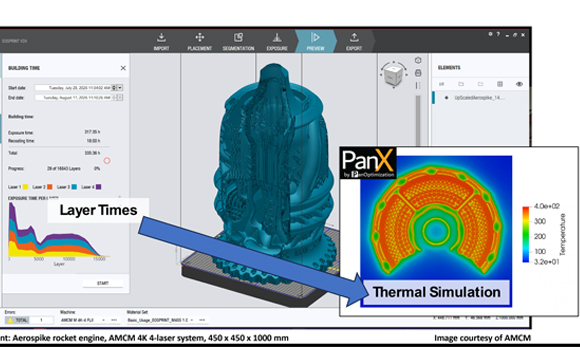
AMCM has demonstrated the workflow on a large build produced using its M 8K. Local heat accumulation in large builds can lead to dimensional distortion, residual stresses, internal defects, reduced part quality, partially sintered powder and difficulties during depowdering. Thermal simulation can be used to identify hotspots before a build begins and allow overheating to be addressed before it affects part quality.
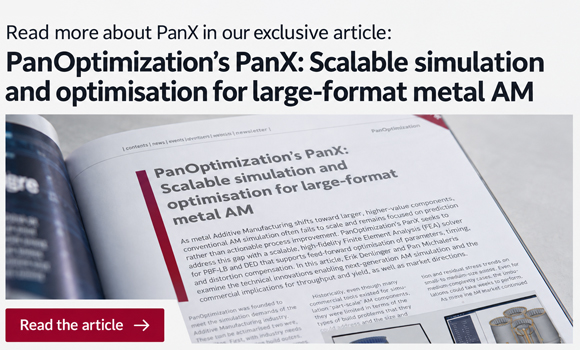
As previously covered by Metal AM, PanX has been developed to enable thermomechanical simulation of large and complex metal AM components. An earlier example involving the AMCM M 8K simulated a component measuring 820 × 820 × 1,200 mm while retaining detailed representation of the geometry.
“AM is moving into a phase where simulation has to become a standard part of the manufacturing process,” added Erik Denlinger, Co-Founder and Chief Engineer at PanOptimization. “If manufacturers want to print and qualify high-value metal AM parts with confidence, they need physics-based models that help them understand and optimise what will happen before the build begins.”
PanX can also be used as a standalone thermomechanical simulation tool with metal Additive Manufacturing machines independently of the EOSPRINT integration.