Walter Reed gains FDA clearance for cranial implant
Walter Reed National Military Medical Center (WRNMMC), Bethesda, Maryland, USA, has received premarket clearance from the US Food and Drug Administration (FDA) for a patient-specific Titanium Cranial Plate (TCP), enabling wider distribution to approved point-of-care facilities.
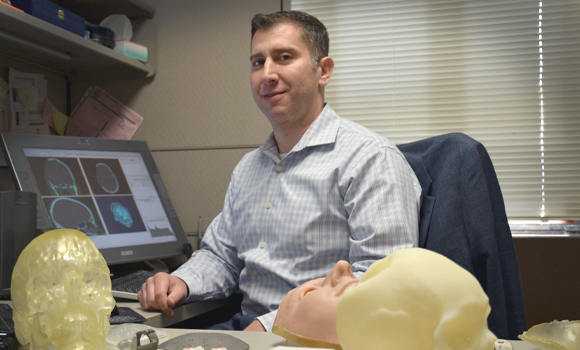
Designed by Dr Peter Liacouras, director of services for Walter Reed’s 3D Medical Applications Center (3D MAC), the plate is intended to reconstruct complex cranial and facial defects resulting from trauma, disease or cancer.
The 3D MAC, part of Walter Reed’s Department of Radiology, focuses on the design, development and manufacture of medical models, implants, surgical guides and custom devices.
“The former National Naval Medical Center (NNMC) began using medical 3D printing in the late 1990s, and the former Walter Reed Army Medical Center (WRAMC) created the 3D MAC in the early 2000s,” Liacouras explained. “When I joined the centre in 2006, I helped streamline many of the methods used to create the models, devices and implants.” NNMC and WRAMC merged in 2011 to form WRNMMC.
Before titanium became widely used for implants, polymethyl methacrylate (PMMA) was commonly used to restore structural integrity. However, unlike titanium, PMMA does not integrate effectively with surrounding tissue. Titanium is biocompatible and can promote tissue integration, helping establish a stable, long-term connection.

“One feature of the TCP is that the fixation bars are already incorporated into the design, so you can simply place it and screw it down,” Liacouras stated. “You can also plan the fixation locations using the CT scans and the 3D reconstructions. We can produce these quite quickly because we receive the CT scans and carry out all the design and manufacturing in-house.”
In 2020, Liacouras and his team began working with Dr Beth Ripley, Deputy Chief of the Office of Healthcare Innovation and Learning at the VA Puget Sound Health Care System, to prepare for anticipated regulatory requirements governing point-of-care Additive Manufacturing.
“While point-of-care 3D printing has been around for quite a while, there have been no clear regulations around it,” Liacouras said. “When the FDA began introducing additional regulations a few years ago, Dr Ripley and I decided to get ahead of the situation. We applied for a Joint Incentive Fund (JIF), which helped us each implement a Quality Management System (QMS), which you need to comply with FDA regulations.”
To obtain FDA 510(k) clearance for commercial distribution in the United States, manufacturers must demonstrate that a device is substantially equivalent to a legally marketed product and provide supporting performance and safety data.

Nikki McMinn, one of the 3D MAC’s biomedical engineers, explained that the submission process, while lengthy, progressed smoothly.
“We received clearance the first time around, which isn’t always the case for new companies or new groups like ours. This was our first submission.”
Walter Reed’s 510(k) submission for the TCP system was sponsored by the Defense Health Agency’s (DHA) Office of Regulated Activities (ORA). Following FDA clearance, Walter Reed can distribute the system to other point-of-care facilities within the US Department of Defense and, potentially, the Department of Veterans Affairs.
“Additive Manufacturing is changing how we deliver patient care and puts a critical capability directly into the hands of our military providers,” stated US Army Lt Col Andrea Mountney, Deputy Director of the ORA. “By securing 510(k) clearance for the 3D MAC Titanium Cranial Plate System, we are delivering patient-unique implants at the point of care, accelerating casualty treatment, improving surgical outcomes and speeding the recovery of our wounded service members. The Defense Health Agency Research and Development’s ORA is proud to have partnered with Walter Reed to provide the regulatory support that has transformed battlefield-driven innovation into an FDA-cleared standard of care for those who serve.”
The group is also developing a custom titanium ridge augmentation matrix (CTRAM) for dental reconstruction in patients who lack sufficient bone to support a conventional implant. The patient-specific device is designed to regenerate bone in the required location. After six to eight months, sufficient bone is regenerated to allow placement of a dental implant.
FDA clearance also enables the 3D MAC to pursue broader opportunities in implant development and collaboration across military medicine.
“One of the other aspects we’re trying to encompass is bringing other facilities into the programme as contract designers,” Liacouras said. “They’ll be able to work under our Quality Management System and comply with our design envelope for these implants. Other military institutions will be able to design devices for their patients, send us the files, and we can manufacture them here before returning the finished implants.”