UCSB researchers develop faster thermal model for PBF-LB
Researchers at the University of California Santa Barbara (UCSB), USA, have developed an experimental–computational framework that reconstructs the three-dimensional thermal history of a melt pool during Laser Beam Powder Bed Fusion (PBF-LB) Additive Manufacturing, enabling accurate prediction of microstructural evolution while dramatically reducing simulation time.
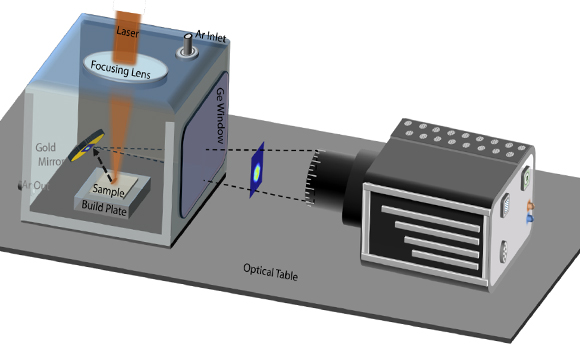
Published in Communications Materials, the research combines high-speed, in-situ infrared (IR) thermography with a transient three-dimensional multiphysics model to capture the rapidly changing temperatures generated during laser melting of the nickel-based superalloy MAR-M247. The approach provides experimentally validated predictions of sub-surface temperatures, solidification conditions and resulting microstructures that have previously been difficult to obtain with sufficient spatial and temporal resolution.
Laser heating during metal Additive Manufacturing creates extreme thermal gradients that determine how a material solidifies and, ultimately, the properties and integrity of the finished component. Conventional high-fidelity simulations are computationally expensive, whereas experimental measurements are generally limited to surface temperatures. The UCSB team’s approach combines both methods, using measured surface temperatures as transient boundary conditions to reconstruct the full three-dimensional thermal field beneath the surface.

The researchers report that the integrated framework can estimate local cooling rates, solidification velocities and melt pool geometry while reducing computational cost by up to three orders of magnitude compared with conventional high-fidelity simulations.
Using the reconstructed thermal data, the model predicted variations in cell spacing and growth direction caused by different laser processing parameters. These predictions were subsequently validated using scanning electron microscopy (SEM) and electron backscatter diffraction (EBSD), with the experimentally observed microstructures closely matching those predicted by the model.

The work also revealed significant variations in solidification conditions near the melt pool surface, highlighting the influence of melt pool convection on local microstructure development. According to the researchers, establishing this direct relationship between thermal history, solidification behaviour and microstructural evolution could help manufacturers better understand how process parameters affect final part quality.
Beyond improving thermal characterisation, the team believes the experimentally validated datasets generated by the framework could provide training data for reduced-order and physics-informed machine learning models. Such models may support future developments in defect detection, process optimisation and layer-by-layer microstructure-aware manufacturing.
The unedited version of ‘Coupled infrared imaging and multiphysics modeling reconstruct three-dimensional solidification dynamics during metal laser melting’ is available here.