Australian research targets certifiable DED-LB repairs for military aircraft
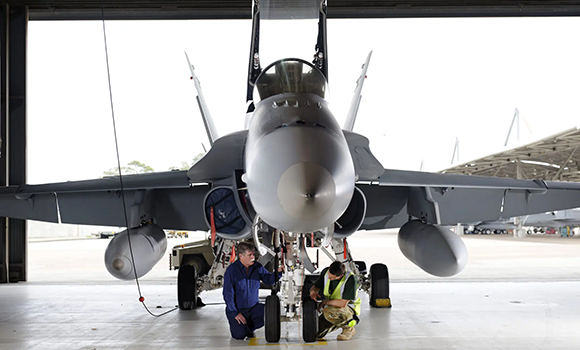
Australia’s Rosebank Engineering, RMIT Centre for Additive Manufacturing and Swinburne University of Technology are set to develop a certifiable Laser Beam Directed Energy Deposition (DED-LB) repair process for high-value aerospace alloys. This two-year research project is supported by the Additive Manufacturing Cooperative Research Centre (AMCRC).
The research focuses on aerospace alloys, including Inconel, titanium alloys and 15-5PH stainless steel. Although the feedstock type for the new project has not been specified, the partners’ previous DED-LB repair work has used metal powder. The aim is to demonstrate a repair process for an advanced military aircraft component that meets the requirements of the Original Equipment Manufacturer (OEM) and NASA-STD-6030. The project will also explore repair pathways for F/A-18 engine components.
Laser rescanning will be used to control the microstructure during the repair process and potentially eliminate the need for post-process heat treatment. Rosebank Engineering will lead process development and validation, using its Adaptive Monitoring and Control of Laser Additive Deposition (AMCLAD) technology to support consistent and repeatable repair outcomes.
Jarrod Watts, Senior Manager Engineering and Projects at Rosebank Engineering, said: “These types of high-value components are currently sourced – in the sustainment environment – from complex international supply chains with long lead-times. We know laser offers the opportunity to repair in-country with significant cost and lead-time reductions. This project tackles that challenge directly.”
Watts added: “Through the use of our AMCLAD capability, and in-process refinement of the microstructure, we can deliver material performance that meets aerospace requirements without risking distortion or damage of the original component.”

Professor Milan Brandt of RMIT Centre for Additive Manufacturing commented on the laser process optimisation:
“Laser rescanning allows us to refine microstructures in ways conventional heat treatment cannot achieve in repair scenarios. By controlling phase transformations during deposition, we can unlock performance levels that meet aerospace standards.”
Researchers at RMIT Centre and Swinburne University of Technology will test tensile strength, fatigue life, residual stress, corrosion and wear performance, forming a detailed Material Property Suite aligned with NASA standards.
“Australia has strong Additive Manufacturing research capability. AMCRC exists to translate that strength into commercial and defence outcomes,” said Simon Marriott, Managing Director of AMCRC. “This project exemplifies that mission – industry-led, defence-relevant, and built around certification from day one. By enabling certified local repair, we strengthen sovereign manufacturing capability and deliver long-term economic and strategic benefit.”