Saab and Divergent collaborate on additively manufactured fuselage

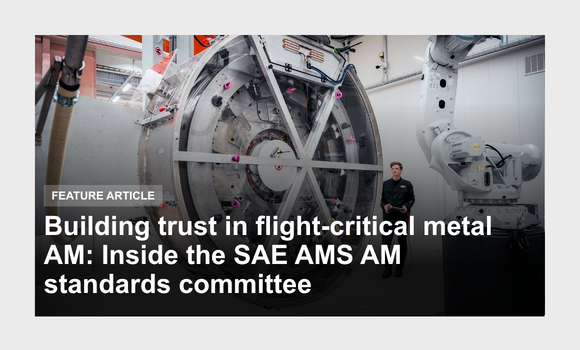
Saab AB, headquartered in Linköping, Sweden, reports it has worked with Divergent Technologies, Torrance, California, USA, to design and additively manufacture a software-defined aircraft fuselage. The fuselage was developed and realised without the use of unique tooling or fixturing, instead utilising the Divergent Adaptive Production System (DAPS™), an end-to-end structural engineering design and manufacturing system that leverages AI-driven design, Laser Beam Powder Bed Fusion (PBF-LB) Additive Manufacturing, and universal robotic assembly.

At over five metres long and comprising twenty-six unique additively manufactured parts, the fuselage will be one of the largest AM metal structures to undergo powered flight.
“Many traditional truths in aircraft manufacturing were possible to challenge by the joint Saab & Divergent design team,” stated Axel Bååthe, head of Saab’s internal startup for transformative innovation known as the Rainforest. “With Additive Manufacturing, load-bearing structufres do not have to follow straight lines and right angles as ribs and stringers, but can rather, organically, follow the optimal load-paths. It is impossible to, as a human, draw these parts, instead they must be generated by optimisation and AI-algorithms.”
This innovative approach to industrial hardware manufacturing enables the team to rapidly produce, test, and iterate physical structures at speeds comparable to those of software engineering workflows. The lead time from design to finished product is no longer dictated by expensive investments in new tooling but is instead determined by the speed of design algorithms and Additive Manufacturing build time. This approach also reduces the cost of change, making redesign and implementing innovative ideas easier.
With this technology, the number of parts in a fuselage can be reduced by at least a factor of 100, claimed Saab, replacing traditional riveted machine parts with organic, interwoven structures. This leads to dramatically lower lead times in assembly.
“This collaboration with Saab highlights what becomes possible when ambitious aircraft concepts are paired with an end-to-end, software-defined manufacturing platform,” said Lukas Czinger, co-founder and CEO of Divergent. “By tightly integrating digital design, Additive Manufacturing, and automated assembly, our teams were able to realise a large-scale fuselage structure aligned with Saab’s vision, while moving with a level of speed, flexibility, and structural integration that traditional approaches cannot match.”
The technology also enables more flexible weight optimisation and functional integration within fuselage structures, allowing for the building of wiring, thermal management systems, and hydraulic and liquid systems directly inside the structure, further improving performance.
Divergent’s early customer base included luxury automotive OEMs such as Aston Martin, Bugatti, and McLaren. In 2022, the company expanded into aerospace and defence and has contracts with dozens of aerospace and defence customers. The company’s technology enables faster development cycles, higher performance, and lower cost structures for customers.
Saab’s additively manufactured aircraft fuselage has successfully passed its structural proof-loading and is scheduled to fly in 2026. “The joint team has done an excellent job working to prepare for first flight and in paving the way forward as we advance towards our ambition of ‘CAD in the Morning, Fly in the Afternoon,” concluded Bååthe.