Researchers develop EIGA aluminium powder for foamable WAAM wire
Researchers at Leibniz University Hannover, Germany, have developed a custom aluminium alloy and produced pre-alloyed powder by Electrode Induction Melting Inert Gas Atomisation (EIGA) for use in metallic foams. The material is ultimately intended for the production of foamable wire for Wire Arc Additive Manufacturing (WAAM).
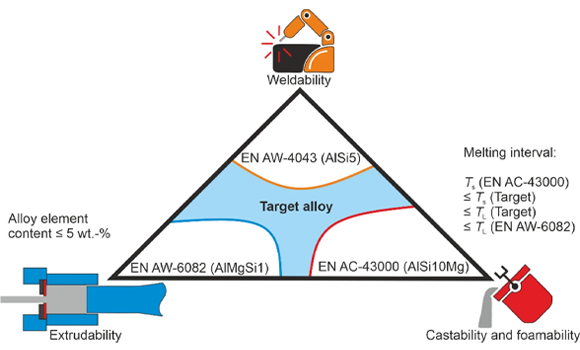
The research, published in The International Journal of Advanced Manufacturing Technology, focused on developing an aluminium alloy with a melting range suited to the production of metal foams while retaining sufficient workability for subsequent extrusion into thin wire.
Metal foams combine low density with properties including stiffness, energy absorption and damping. One established Powder Metallurgy production route involves mixing metal powder with a blowing agent and compacting the mixture into a precursor. During subsequent heating, gas released by the blowing agent causes the material to expand and form a porous structure.
For the study, the researchers developed the AlMg2Si1.2 alloy, containing nominally 2 wt.% magnesium and 1.2 wt.% silicon. Thermodynamic calculations were used to select a composition containing less than 5 wt.% alloying elements and with a liquidus temperature below the principal hydrogen-release peak of the pre-treated titanium hydride (TiH₂) used as the blowing agent.
The alloy was cast into cylindrical billets before being extruded into rods and machined into electrodes. These were processed using an EIGA 70–500/VIGA 2B inert gas atomisation system from ALD Vacuum Technologies.
Five atomisation runs were carried out using argon, with gas pressures ranging from 16.8–23.0 bar. Increasing the atomisation pressure reduced the median particle size from 51 µm to 40 µm. The resulting powders were predominantly spherical, with the 63–90 µm fraction showing the best flow properties.
One powder batch, produced at an atomisation pressure of 20.3 bar, was selected for further investigation based on its stable atomisation conditions and particle size distribution. This powder had d10, d50 and d90 values of 20 µm, 44 µm and 76 µm, respectively.
Differential scanning calorimetry determined a solidus temperature of 560 ± 2°C and a liquidus temperature of 646 ± 2°C. This positioned the alloy’s melting interval to overlap with the hydrogen release from TiH₂ that had been pre-treated in air at 480°C for 180 minutes.
To demonstrate foamability, selected powder fractions were mixed with 0.7 wt.% TiH₂ and compacted into precursors before being heated to produce foam samples. X-ray microscopy showed porosities of 64.1–67.7%. No statistically significant difference in porosity or median pore size was found between foams produced using the 45–63 µm and 63–90 µm powder fractions.
The researchers concluded that the AlMg2Si1.2 powder provides a suitable basis for the Powder Metallurgy production of foamable material. Work is now underway to extrude the developed powder into foamable wires and integrate these into a WAAM process.
The longer-term aim is to deposit the foamable wire before using a secondary heat source to selectively foam the material, potentially enabling components incorporating dense and porous regions with locally tailored properties.
The full paper, ‘Powder-based porous materials for Additive Manufacturing: alloy design and custom atomization process’, is available here