High laser power and precise beam shaping in compact DED head
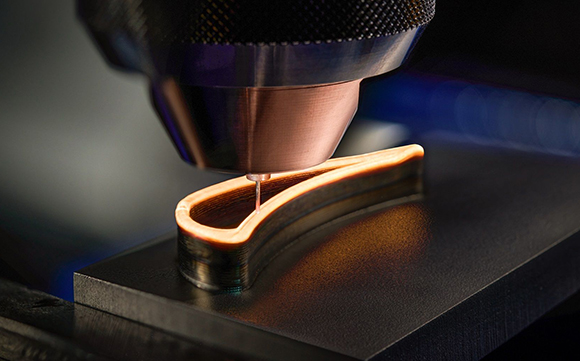
The Fraunhofer Institute for Laser Technology ILT (Fraunhofer ILT), located in Aachen, Germany, and Cailabs, based in Rennes, France, are entering a development partnership to advance wire-based laser material deposition for demanding industrial applications.

Under the partnership, Cailabs is contributing a new, particularly compact process head based on its Multi-Plane Light Conversion (MPLC) technology. This coaxial beam-shaping principle distributes the laser energy in a controlled and reproducible way around the wire, intended to allow for precise control of the energy input, even at high power levels.
The head weighs less than five kilograms and allows the use of laser powers above twelve kilowatts. This combination of compact size, high available laser power and precise beam shaping has not been available in this form before, state the companies.
Building on this, Fraunhofer ILT is developing suitable process parameters and qualifies the system for various applications across different industrial sectors. The precise beam profile supports a consistent energy input into the wire. This enables uniform deposition even where fine contours or locally confined material build-up are required.
The aim of the collaboration is a compact head, light enough to be mounted directly on a robot arm and smoothly integrated into existing systems. At the same time, the partners intend to enable the use of laser power levels above twelve kilowatts. This will support the repair and build-up of larger components and help reduce processing times.

“At Cailabs, we aim to develop products with strong industrial impact, built on our core beam-shaping technology,” said Jean-François Morizur, CEO of Cailabs. “We believe this collaboration with Fraunhofer ILT will demonstrate the full potential of our approach for advanced manufacturing.”
In many industrial applications, such as turbine or tool repair, very small and precise structures are required. With the new beam profile and Fraunhofer ILT’s process know-how, structures with a width below one millimetre are targeted, an important step toward precise repair and high-resolution hybrid manufacturing.
Dr Thomas Schopphoven, Head of Laser Material Deposition at Fraunhofer ILT, shared, “We have already developed wire-based deposition processes for critical applications such as aerospace, energy systems and tooling. This experience flows directly into process control, material selection and analysis of melt pool dynamics.”
The team led by Schopphoven is currently defining parameter windows for different processing scenarios using physics-based simulations. This includes tuning wire feed, wire diameter, laser power and guideway strategies for different materials. In parallel, the robot-guided system environment is being set up, where the Canunda-DED head will be tested.
Cailabs’ MPLC technology uses several phase-shaping planes to form stable and reproducible beam profiles. The approach has reportedly proven effective in fields where high beam quality is crucial, such as aerospace, optical communications and industrial laser processing. It is low-loss, robust and stable even at high power levels.
The two partners are currently preparing system trials. The focus is on coordinating beam profile, wire feed and guideway to achieve stable operation under continuous use. In parallel, preparations are being made for real industrial use cases, such as the repair of complex component geometries or the build-up of fine edges.