Callaway patent details Binder Jetting for golf club head structures
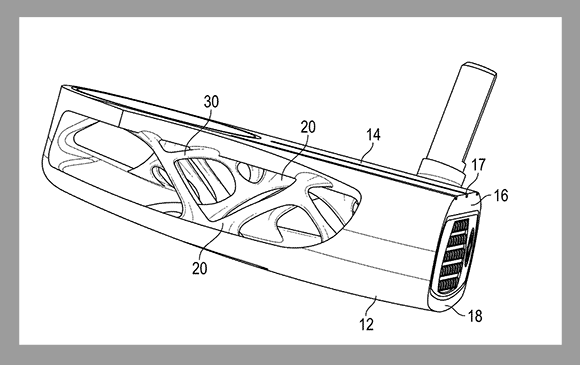
Callaway Golf Company, headquartered in Carlsbad, California, USA, has been granted US Patent 12,685,908, which covers structural support designs for golf club heads and identifies Binder Jetting (BJT) Additive Manufacturing as a preferred manufacturing route. The patent, Support structures for golf club heads and methods of manufacturing improved support structures, was granted on July 21, 2026.
Although principally directed at putter heads, the patent states that the designs may also be applied to drivers, fairway woods, irons and wedges. The proposed structures comprise networks of slender, interconnected members with continuously changing curvature and cross-sectional geometry, enabling designs that can be difficult to manufacture using conventional methods.

Callaway identifies Binder Jetting as the preferred Additive Manufacturing process for producing the structures. In the described process, layers of powder are spread across the build area and a liquid binder is selectively deposited to form a green part. This may then undergo debinding before being sintered to consolidate the material.
A key focus of the patent is the design freedom that Callaway says Binder Jetting offers compared with laser- and electron-beam metal Additive Manufacturing processes. The specification states that fusion-based processes can impose restrictions on overhang angles and require supports connected directly to the component. Such constraints can limit the orientation and geometry of beams within fine lattice structures and make topology-optimised designs more difficult to manufacture.
In contrast, the patent states that the powder surrounding a Binder Jetting build can provide support during processing, allowing green parts to be stacked in three dimensions and reducing the need for structures connected to a build plate. According to Callaway, this makes warped, twisted, curved and variable-density lattice structures practical, including geometries incorporating beams that would otherwise violate overhang restrictions associated with fusion-based processes.
Of particular relevance to the Powder Injection Moulding industry, Callaway states that Binder Jetting can use standard metal powders common to Metal Injection Moulding (MIM). The company points to the established MIM powder supply chain as a potential source of lower-cost feedstock compared with the finer, tightly specified powders used in some fusion-based Additive Manufacturing processes. Together with three-dimensional stacking and batch debinding and sintering, the patent argues that these factors could make Binder Jetting applicable not only to customised golf clubs and prototypes, but also to larger-scale production.
The design approach also employs generative design and topology optimisation. The patent describes lattice structures with locally varied cell size, aspect ratio, skew and beam diameter, allowing effective density and stiffness to be adjusted across a component.
In one putter-head embodiment, the internal support structure is used to redistribute mass within the club head, allowing discretionary mass to be positioned in higher-density regions around the heel, toe or rear. Callaway states that this redistribution can be used to modify the centre of gravity and moment of inertia, among other performance characteristics. Other embodiments described in the patent include lower-density polymeric inserts, underlining that the patent is not limited to entirely metal Binder Jetted putter constructions.
The newly granted patent forms part of a long-running family of continuation and continuation-in-part applications. Its lineage includes utility applications filed from 2020 onwards, claims priority to earlier provisional applications, and traces back to design patent applications filed in 2018 and 2019.