BLT and Haptron scale AM sensors for humanoid robots
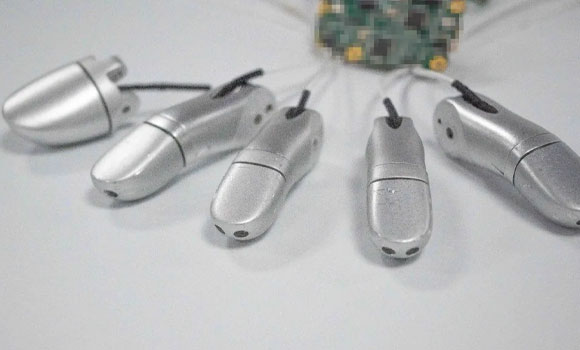
Xi’an Bright Laser Technologies (BLT), based in Xi’an, China, and Haptron Scientific, Shenzhen, have collaborated to advance the development and production of multi-dimensional force sensors for humanoid robotics and industrial automation applications.

As demand increases for high-precision force sensing, particularly for stable interaction and manipulation, the companies have combined sensor design with metal Additive Manufacturing in a move towards industrial deployment.
Miniaturised sensors for robotics applications
Haptron has developed a range of optical multimodal force sensors, including the Photon Finger and the PhotonR40 wrist sensor. These components are designed to balance compact size with high performance, supporting applications in humanoid robotics where six-axis force sensing is required for control and interaction.
The complex internal geometries of these sensors present challenges for conventional manufacturing processes, particularly in terms of consistency and scalability. BLT’s metal Additive Manufacturing approach enables the production of integrated structures with reduced assembly requirements, supporting improved repeatability
Performance and material optimisation
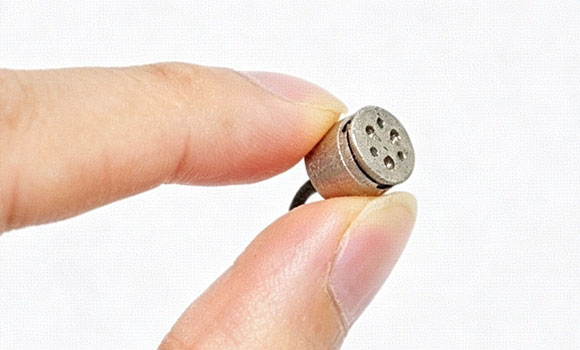
The companies state that the second-generation Photon Finger Max achieves a measurement range of 700 N within a 9.5 mm diameter form factor, extending capability into higher-load applications.
Using metal Additive Manufacturing, the component is produced in 18Ni350 maraging steel, achieving a reported tensile strength of approximately 2400 MPa following heat treatment. Structural optimisation is said to support stability under high-frequency and high-load operating conditions.
System integration for dexterous robotics
BLT and Haptron have also focused on system-level integration. The PhotonFinger-5in1 dexterous hand integrates multiple sensors within robotic fingers, enabling detection of contact conditions, force direction and slip.
For wrist-level sensing, the PhotonR40 incorporates a through-hole design intended to improve integration within robotic systems. The companies report a weight reduction of 20-30% through monolithic Additive Manufacturing, contributing to improved system performance.
High-resolution Additive Manufacturing, combined with calibration processes, is used to support consistency across production batches.
Scaling production
To support increased demand, BLT has developed production strategies using large-format Additive Manufacturing machines. The Photon Finger-B sensor, measuring 8.5 mm × 8.5 mm × 6.91 mm, can be produced in volumes of up to 972 units per build, according to the company.
Surface roughness is reported at Ra 2–3, with dimensional tolerances within 0.05 mm. BLT states that several thousand units across the Photon Finger series have already been delivered, supporting applications in robotics, prosthetics and industrial automation.
Towards industrial adoption
BLT and Haptron Scientific state that multi-dimensional force sensors are moving towards wider industrial adoption, driven by advances in design, integration and manufacturing scalability.
The companies suggest that metal Additive Manufacturing is increasingly being used for series production of miniature, high-precision components, where its ability to produce complex geometries with consistency offers advantages over conventional manufacturing methods.