BLT and Haptron highlight potential of metal Additive Manufacturing for humanoid robotics
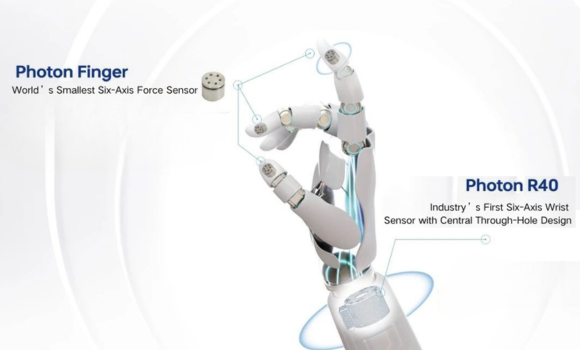
In anticipation of the industrial deployment of humanoid robots, Chinese companies Xi’an Bright Laser Technologies Co., Ltd (BLT) and Haptron Scientific, Guangdong, have developed a suite of six-axis force/torque sensors – including the Photon Finger, PhotonR40, Photon Ankle, and the latest industrial-grade Photon Finger Max – which target key robotic joints such as fingers, wrists and ankles.
Haptron Scientific integrated BLT’s metal Additive Manufacturing technology with its proprietary optical multimodal sensing technology to produce complex miniaturised designs with fewer parts and simpler assembly while focusing on precise and durable production. The lightweight force sensors are expected to enable safer, more dexterous and versatile robotic platforms.

Photon finger
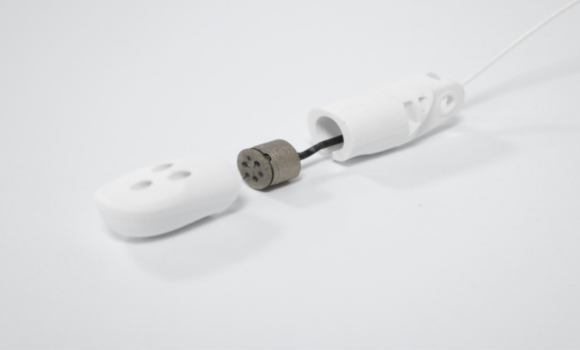
Designing dexterous hands for humanoid robots presents unique challenges. This is especially true for finger joints, where space is extremely constrained. These tight dimensions demand compact, high-performance sensors with seamless integration. To address the limitations of traditional machining (e.g. high cost, long lead times, and low yield), Haptron Scientific has developed what it has referred to as the ‘world’s smallest six-axis force/torque sensor’.
The Photon Finger allows humanoid robots to perform functions such as grasp control and material compliance detection. Using BLT’s BLT-A100 Laser Beam Powder Bed Fusion (PBF-LB) Additive Manufacturing machine and 18Ni350 maraging steel powder, the Photon Finger was structurally optimised for integration and part count reduction through one-piece metal Additive Manufacturing. This enabled:
- Miniaturised design tailored for tight finger joint integration
- Twenty-minute batch production cycle, with 15-30 units additively manufactured simultaneously
- 50–250% improvements in force range and overload tolerance
- Improved signal integrity, lower in-use power consumption, and faster communication, well-suited to rapid integration and iteration
PhotonR40 wrist joints
In December 2024, Haptron Scientific launched the PhotonR40, a high-performance six-axis force/torque sensor with a central through-hole structure that is specifically designed to simplify force sensing integration in humanoid robot wrists.
The wrist joint plays a crucial role in enabling humanoid robots to perform tasks. A lighter six-axis force/torque sensor at the wrist can significantly enhance a robot’s flexibility, agility, task efficiency, and battery life.
BLT supported the mass production of the PhotonR40’s core structure using lightweight materials, reportedly achieving a 20–30% reduction in weight while improving overall sensor performance. This, in turn, enhances the robot’s stability and balance. In addition, BLT’s metal Additive Manufacturing technology again enabled the one-piece fabrication of complex internal geometries, reducing assembly complexity and increasing production efficiency.
Ankle joint sensor
The six-axis force sensor for the ankle joint is critical. Used to measure force and torque during walking, standing, and other human motions, the joint requires exceptional strength, overload capacity, and long-term reliability. By leveraging BLT’s metal AM technology and materials, Haptron Scientific’s sensor is said to offer a load capacity increased to 8000N / 500N·m, a yield strength able to reach 2400 MPa, and an overload capacity that has been enhanced to 300%.
Photon finger max
A second-generation optical-based multi-axis force sensor, featuring a compact 9.5 mm diameter form factor, has been engineered for the seamless integration into robotic fingertips and end-effectors. The sensor’s structures have been topology-optimised for superior mechanical performance, allowing the piece to achieve a 23× increase in load capacity – up to 700 N –over the previous generation. The sensor reportedly passed high-frequency, high-load testing, while the refined assembly interfaces streamline integration and accelerate iterative development for robotic applications.
The expanded measurement range enables the sensor to meet a broader spectrum of application scenarios, from lightweight human-robot interaction in domestic service robots to mid-to-high force tasks in industrial automation.
Working to accelerate the robotics industry
Throughout the collaboration, BLT’s PBF-LB technology is reported to have enabled design flexibility, accelerated delivery, consistent performance and cost efficiency. These capabilities, it is stated, position AM as a powerful enabler for the evolving needs of the robotics industry, from prototyping to mass production.
BLT and Haptron Scientific plan to continue exploring applications in robotics, Additive Manufacturing and new materials and, in doing so, accelerating the path toward smarter, more autonomous manufacturing.
www.xa-blt.com
www.haptron-scientific.com