Arc Impact outlines BJT scale-up for aerospace and defence
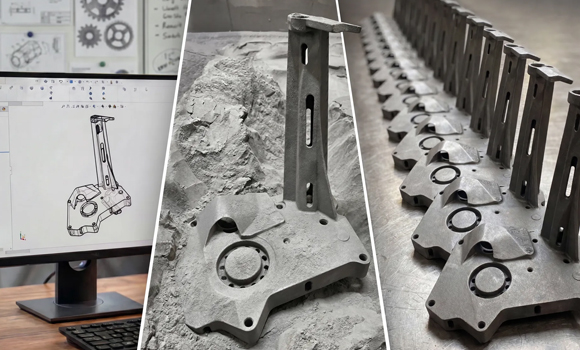
Arc Impact, Burlington, Massachusetts, USA, a provider of metal and ceramic Binder Jetting (BJT) solutions, has outlined its approach to developing and scaling production applications for the aerospace and defence sectors. Through its AM2 Production framework, the company works with manufacturers to develop production workflows intended to meet dimensional, material and commercial requirements.
The company specialises in materials science, Powder Metallurgy and ceramics, and offers powder-based and bound-metal machines, sintering furnaces and software. Its activities cover materials selection, applications development, process qualification and the integration of downstream manufacturing processes.
According to Arc Impact, the challenge for aerospace and defence applications is increasingly not whether a complex geometry can be produced, but whether the complete manufacturing process can provide the repeatability, dimensional control and material performance required for qualification and serial production.
Its AM2 Production framework addresses materials and applications development, candidate-part evaluation, design optimisation, manufacturing work cell implementation, technical and business validation, and production scale-up. This includes upstream and downstream stages such as powder selection, sintering, machining, finishing and inspection.
One material being addressed through this approach is silicon carbide. Advanced ceramic components can be required to meet tight tolerances while operating under demanding thermal and mechanical conditions. Arc Impact identifies potential aerospace and defence applications ranging from spaceborne optics to thermal management and protection systems, including components for propulsion, sensing and survivability.

The company’s X-Series BJT machines are designed to process metal and ceramic materials, including non-oxide ceramics such as silicon carbide. Open process parameters are said to enable adjustment of factors including powder morphology, binder saturation and sintering profiles.
The X25Pro provides a mid-sized platform for benchmark parts and early-stage programmes, including process development, densification studies and dimensional evaluation. The larger X160Pro is intended to apply established processes at production scale, accommodating larger components, batches or arrays where throughput and cost per part become greater considerations.
Arc Impact stated that its objective is to establish qualified manufacturing routes capable of progressing high-value components from initial development to serial production without changing the underlying BJT process.
Process control is supported by the company’s Live Suite software, which provides scan-based deformation correction, tolerancing and tools to predict and manage dimensional performance following sintering.