AMCM introduces AirSword gas flow concept for large-scale PBF-LB
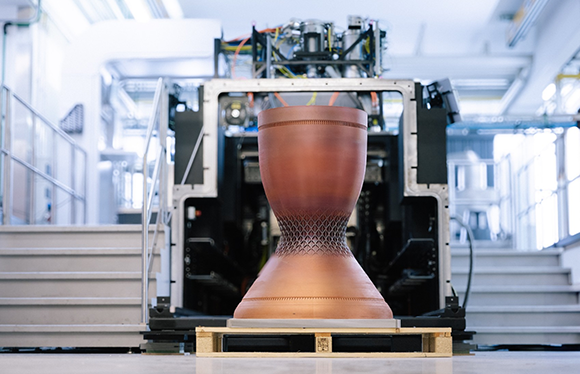
AMCM GmbH, based in Starnberg, Germany, has introduced the AirSword gas flow concept, a precision-engineered gas flow management system designed to elevate the performance of large-format Laser Beam Powder Bed Fusion (PBF-LB) Additive Manufacturing machines. The company states that this is achieved by combining the high speed and precision of fixed scanner systems with a fundamentally revised gas flow approach.
Traditional gas flow methods often struggle in larger spaces, explains AMCM, resulting in uneven distribution, turbulence and suboptimal outcomes. Effective gas flow is essential for removing by-products such as spatter and soot, maintaining an inert environment and ensuring the production of high-quality parts, especially on ultra-long builds.
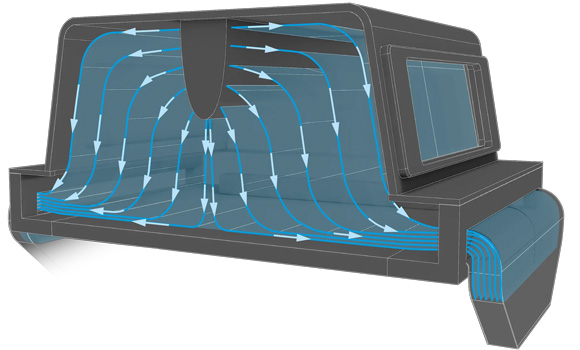
The AirSword reportedly introduces a dynamic, multi-layered, and seamless gas flow that spans across the entire building area. This flow actively pushes smoke and soot directly toward the exhaust, maintaining optimal process conditions even in large chambers like those of the M 8K and the upcoming M 10K.
At the heart of the system is a central gas-emitting device that splits the flow into two opposing streams along the chamber’s axis. The key advantage of this design is reportedly that smoke from the simultaneously generated melt pools neither reaches the opposite side nor lingers at the point of origin, eliminating any possibility of laser-smoke interaction. Instead, the smoke is extracted sideways for each half, ensuring a clean, interference-free process.
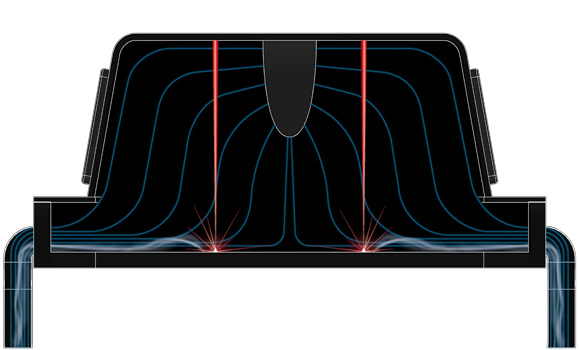
Another critical benefit of the AirSword concept is said to be its ability to keep cover glasses and the laser travel path free from smoke, a persistent challenge in long-duration PBF-LB build jobs. Accumulated soot and vapour plumes can degrade laser quality and part precision over time. AirSword’s ceiling-directed stream efficiently clears the area in front of the optics, ensuring clear laser paths and consistent performance throughout extended builds.
The AirSword is said to significantly reduce maintenance downtime and boost productivity, making it an appropriate candidate for high-volume, long-term manufacturing.
Georg Fey, Team Manager Application & Innovation at AMCM, shared, “We designed the AirSword concept using extensive Computational Fluid Dynamics (CFD) simulations to optimise flow patterns for large LPBF chambers. These simulations guided the design of the flow nozzle outlets and overall flow dynamics. The device itself is manufactured on our M 4K system, leveraging LPBF’s design freedom to create a highly efficient, custom-fit gas flow solution.”
The M 8K, equipped with eight 1 kW lasers and a 0.7 m² powder bed, enables the production of intricate, high-precision components. It builds on the success of the M 4K, introducing new design principles such as the AirSword, offering an 800 x 800 x 1200 mm build volume. The system is designed for high-productivity applications and handles up to 5 tons of powder with precision along its z-axis.
The AirSword is also suitable for even larger systems, such as the M 10K, featuring a 1000 x 1000 mm build area. Martin Bullemer, Managing Director at AMCM, noted, “Designing a system of this size involves a whole range of challenges. The excellent laser, scanner, and optics design, based on decades of process expertise from EOS, ensures reliability. AirSword complements this by maintaining a uniform protective gas atmosphere across the M 8K’s and M 10K’s expansive powder beds, safely dissipating fumes to avoid quality loss over long print times. Integrated with advanced process control technologies like SmartFusion and EOSTATE Exposure OT, AirSword enhances in-process quality assurance, reducing the need for extensive post-build testing.”
Felix Bauer, Head of Sales at AMCM, shared, “There are several concepts how to manage the gas flow over large building envelopes, including mechanically complex systems. We firmly believe that we should stick with a fixed scanner approach combined with optimised airflow for as long as possible, as the advantages in terms of build speed and part quality are unbeatable. Unlike mechanically complex systems, the AirSword’s streamlined design minimises failure modes and enhances reliability. Mechanical complexity often introduces software complexity, increasing the risk of errors. With AirSword’s straightforward approach we avoid these pitfalls.”