Airbus integrates titanium wire DED parts into A350 cargo door assembly

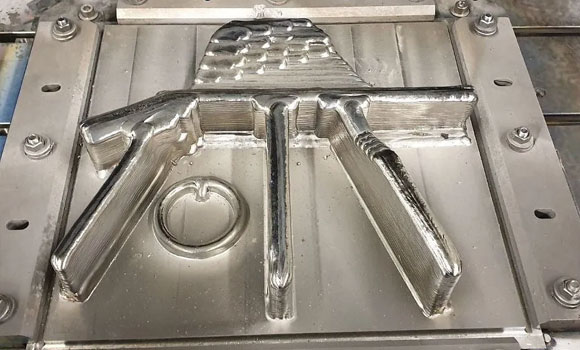
Airbus has reported that it has started serial integration of wire Directed Energy Deposition (DED) parts into the A350’s cargo door surround area. These Airbus-designed parts, produced for this exploratory phase, were additively manufactured by a qualified supplier using plasma w-DED, ultrasonically inspected by Testia Bremen and finally machined and installed in Airbus factories.
These parts are functionally and geometrically identical to the traditional forged components they replace, but they deliver immediate, real-world cost savings. Looking forward, the next aim is to progress, step by step, from the A350 w-DED parts and into more critical applications on other programmes and other aircraft applications (including the wings and landing gear in the longer term).
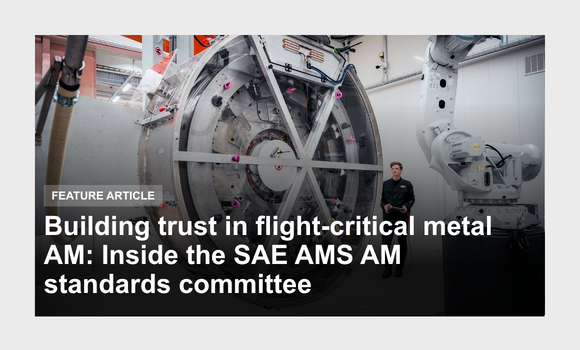
The technique uses a multi-axis robotic arm, armed with a spool of titanium wire, moving with digital precision. Energy, in the form of a laser, plasma, or electron beam, is focused onto the wire, instantly melting it and fusing it layer-by-layer onto a surface. While superficially similar to welding, this process is guided by a 3D model, it additively manufactures the object from the ‘ground up’ into what is known as a ‘blank’. This blank looks very much like the final required shape, i.e. ‘near net shaped’, which subsequently undergoes a quick machining to conform to the exact dimensions of the part design.
While Additive Manufacturing with metals in aerospace has been used for around a decade, up until now it has mostly been used for smaller components. These conventional Powder Bed machines were typically optimised for making parts that are less than two feet long.
Wire DED, on the other hand, allows Airbus to move from manufacturing small components to creating large, structural titanium parts up to seven metres (over 23 feet) long. The new process promises to be faster than Powder Bed Additive Manufacturing, boosting production from hundreds of grammes per hour to several kilogrammes per hour. This leap could make AM viable for industrial, high-volume manufacturing of large structural components for commercial aircraft.
Titanium was selected due to its strength, lightness and compatibility with modern carbon fibre composite structures, such as corrosion resistance, relative expansion coefficients and other properties. But it is also a high-value raw material. Wire DED prevents waste at source, the part is built close to its final design, there is very little to machine away. Contrastingly, in traditional methods, one might need to recycle between 80% and 95% of the titanium originally bought.
Additive Manufacturing reduces lead times from up to two years for traditional die forging to just a few weeks.
This technology also enables a concept called “designed for DED.” Instead of having engineers design a complex component as an assembly of several separate pieces that must be joined together, they can now design it as a single, intricate and optimised component that is manufactured all at once. This ability to merge multiple components into one will simplify the supply chain, reduce assembly labour and shorten cycle time.