Rice students develop low-cost cold spray metal Additive Manufacturing machine prototype
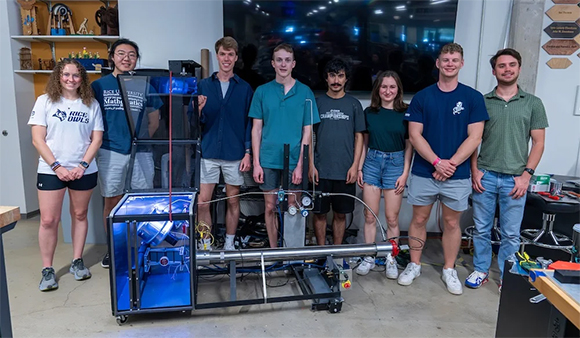
A team of students from Rice University, Houston, Texas, USA, have developed a cold spray metal Additive Manufacturing device that relies on pressure and velocity, rather than temperature, to create a metal part. The team’s work is intended to help expand the repertoire of metal Additive Manufacturing techniques, reduce costs and enhance the quality of making or repairing one-off complex metal parts.
Team AeroForge members – Eli Case, Julianna Dickman, Garrett French, Galio Guo, Douglas Hebda, Grant Samara, Davis Thames and Aasha Zinke – used the device to successfully deposit copper, demonstrating the viability and potential of their prototype. The project won an Excellence in Capstone Engineering Award and first place in the Willy Revolution Award for Outstanding Innovation at the annual Huff OEDK Engineering Design Showcase.
“We’re very excited and very relieved,” Dickman stated. “We spent many late nights in the Oshman Engineering Design Kitchen, and it feels very rewarding to get recognised for our work.”
Team AeroForge’s project is also the recipient of this year’s Hershel M Rich Invention Award, presented to Rice engineering students or faculty members for original invention development.
“Traditional metal 3D printers generally use a laser to melt metal powder into a particular shape, but melting can really impact the properties of your product,” Zinke shared. “Cold spray technology, which has been used for coatings, uses velocity instead of heat, basically accelerating metal particles so fast that they adhere to and deform onto a substrate. The system that we’ve designed aims to accomplish that in a 3D printing capacity.”
Applications for the device include the manufacture and repair of metal parts with a complex structure, such as components used in industrial assembly lines, vehicles, or aircraft. Industries that rely on metal components – automotive, oil and gas, defence – can incur significant losses as a result of supply chain disruptions, so the team hopes its device can provide a viable, low-cost alternative for making or repairing parts on demand.
“Typically with repairs, you can only remove material as you reshape a metal part,” Thames, who first pitched the idea for the project to a teammate almost a year prior to the start of the senior design class, said. “But with this process, you can add material, and then machine it back down. With welding, for instance, varying melting temperatures may result in uneven material properties. We don’t have that issue with this device.”
The device consists of a gas tank that feeds high-pressure nitrogen gas into the system; controls that regulate valves and monitor pressure and temperature; a pressure vessel which heats the gas to 450°C; a powder feeder designed to dispense metal powder into a nozzle at a precise rate; and a custom nozzle.
Dickman explained that while the gas is heated, “it is still a cold spray system because when the gas meets powder in the nozzle, it is expanded out of the nozzle and cools very quickly.”
“The particles never melt, they really never see temperature ⎯ the temperature only serves to increase the speed of the gas, which imparts its momentum on the metal powder, which can then accelerate to our substrate and adhere,” Dickman said.
A lot of the team’s efforts were focused on reducing costs as most metal Additive Manufacturing machines can cost over $1 million, whereas Team AeroForge built its device for less than $5,000.
“One of our big innovations here is making the system so much cheaper,” Samara said. “A lot of our parts were machined in house, for instance the pressure vessel, because that’s potentially a very dangerous thing. Other parts, like the nozzle, are proprietary, so it’s not something that you can find elsewhere. The nozzle is a very difficult part to manufacture, we had to develop new processes to make it.”
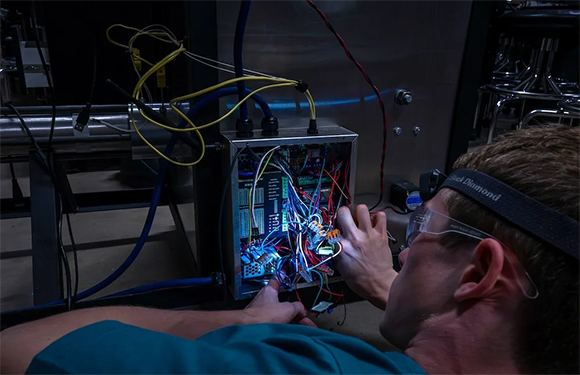
The team worked with the environmental health and safety department at Rice to ensure that the machine abided by all guidelines during testing. One of the safety specifications is that no one is allowed to be in the room while the machine is in operation. To ensure safety, the team implemented a complex monitoring system and a three-part data logging system.
“We’ve implemented lots of security checks,” Guo said. “For example, there’s a particular hierarchy in which you can actually open up the switches. We communicate with the device wirelessly, so we’ve done a lot of code iteration to make sure that that works effectively.”