Elementum 3D’s A7050-RAM2 aluminium aerospace alloy outperforms 7050 wrought
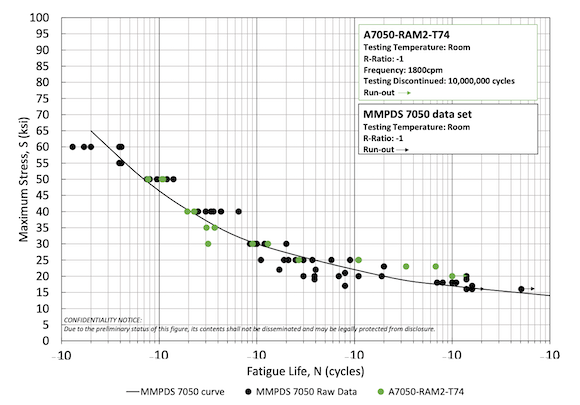
Fig. 1: 3D printing alloy A7050-RAM2 fatigue data (green points) compared with MMPDS 7050 wrought data set (black points with curve fit given by black line), both tested with an R-ratio of -1. MMPDS 7050 wrought data set and fit curve were estimated from Figure 2 (Courtesy Elementum 3D)
Fig. 1: A7050-RAM2 fatigue data (green points) compared with MMPDS 7050 wrought data set (black points with curve fit given by black line), both tested with an R-ratio of -1. MMPDS 7050 wrought data set and fit curve were estimated from Figure 2 (Courtesy Elementum 3D)

A7050-RAM2, an aerospace and speciality Additive Manufacturing aluminium alloy from Elementum 3D, Erie, Colorado, USA, features a combination of high toughness and strength, as well as good stress corrosion cracking resistance.

Fatigue in metals and alloys can lead to the failure of a material at stresses well below the yield point of a material through a cyclic loading of the material in service. The fatigue life of a material is evaluated based on how many cycles it takes for a material to fail at a given stress below the yield strength of the material. To generate a full stress vs fatigue life/cycles curve (S-N curve), multiple dog-bone samples of the material are tested at a variety of stresses.

Test results are reported as a maximum stress, explains Elementum 3D, but fatigue samples are tested based on amplitude and not simply just one stress value (i.e., the samples are pulled, typically in tension, to a max stress and then unloaded down to a maximum stress per cycle). Often the minimum stress is a compressive stress, so the sample is pulled in tension, unloaded, and then loaded under compression.

This stress amplitude is defined by an R-ratio, which, given a maximum stress in an S-N curve, can be used to calculate the minimum stress. An R-ratio of -1 is fully reversible (i.e., the maximum stress is a tensile stress of a given value and the minimum stress is a compressive stress of the same magnitude as the maximum stress [e.g., a maximum stress of 30 ksi implies a minimum stress of -30 ksi, the negative referring to a compressive stress]). Another common R-ratio is 0.1, where the minimum stress is 10% of the maximum stress (e.g. a maximum stress of 30 ksi would imply a minimum stress of 3 ksi). For tests performed at particularly low maximum stresses, run-out can occur, which is when a test is discontinued before the failure of material after a high number of cycles, such as that reported here as 107.
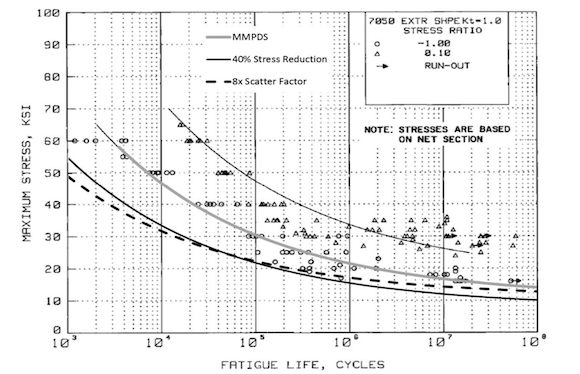
Fig. 2: MMPDS wrought 7050 data set taken from literature, R-ratio -1.1 (Courtesy Elementum 3D)

A7050-RAM2 fatigue results are shown by the green points in Fig. 1. Expected values for 7050 wrought for comparison to A7050-RAM2 were taken from an MMPDS 7050 data set (provided in Fig. 2), shown by the black points and black fit curve in Fig. 1. Results were taken from samples tested with an R-ratio of -1. The A7050-RAM2 data shows similar results as those of the wrought MMPDS 7050 data set.
www.elementum3d.com

TRUSTED CONTENT. TARGETED AUDIENCE

Advertise with Metal AM and access a global base of 50,000+ AM professionals.

Contact Jon Craxford: [email protected]

Request a Media Pack
  • AM machines
  • Process monitoring & calibration
  • Heat treatment & sintering
  • HIP systems & services
  • Pre- & post-processing technology
  • Powders, powder production and analysis
  • Part manufacturers
  • Consulting, training & market data

Don’t miss a thing – register for our newsletter

Don't miss any new issue of Metal AM magazine, and get the latest industry news. Sign up to our twice weekly newsletter.

Register now

Join 40,000+ other AM professionals – follow us online

About Metal Additive Manufacturing magazine

Metal AM magazine, published quarterly in digital and print formats, is read by a rapidly expanding international audience.

Our audience includes component manufacturers, end-users, materials and equipment suppliers, analysts, researchers and more.

In addition to providing extensive industry news coverage, Metal AM magazine is known for exclusive, in-depth articles and technical reports.

Our focus is the entire metal AM process from design to application.

Each issue is available as an easy-to-navigate digital edition and a high-quality print publication.

Discover our magazine archive…

The free to access Metal Additive Manufacturing magazine archive offers unparalleled insight into the world of metal Additive Manufacturing from a commercial and technological perspective through:

  • Reports on visits to leading metal AM part manufacturers and industry suppliers
  • Articles on technology and application trends
  • Information on materials developments
  • Reviews of key technical presentations from the international conference circuit
  • International industry news

All past issues are available to download as free PDFs or view in your browser.

Browse the archive

Share via
Copy link
Powered by Social Snap