Carnegie Mellon University researchers develop sensor to detect COVID-19 antibodies using Optomec’s Aerosol Jet process
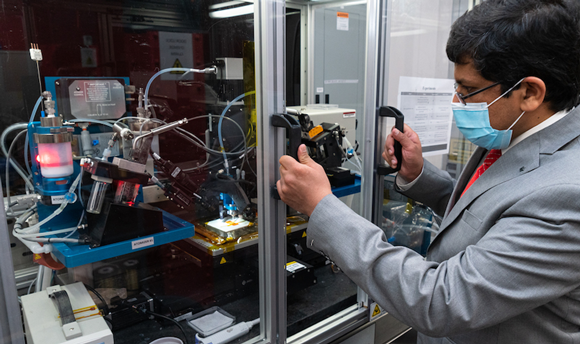
Optomec, headquartered in Albuquerque, New Mexico, USA, reports that researchers from Carnegie Mellon University (CMU) located in Pittsburgh, Pennsylvania, USA, have utilised its Aerosol Jet process to develop a low-cost sensor that is capable of identifying coronavirus (COVID-19) antibodies in approximately ten seconds.
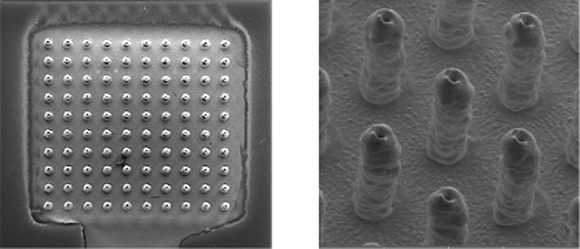
The sensor is based on a special structure of tiny gold electrodes that are additively manufactured using the Optomec Aerosol Jet process. The CMU researchers believe that the sensor will allow clinicians to instantly and accurately detect COVID-19 antibodies due to the specific geometry and surface characteristics of the additively manufactured structure.
Optomec’s Aerosol Jet technology is a production process capable of additively manufacturing extremely precise conductive and non-conductive materials with features as fine as 10 microns. It is used in advanced semiconductor packaging, 3D antenna and sensor production, medical device manufacturing, aerospace and other industries.
For the sensor developed by the CMU researchers, ink droplets containing nanoparticles were placed to build a matrix of 100 gold pillars in 2 mm square at high speed. The pillars were then coated with reduced graphene oxide, which binds the antibodies to the gold electrodes.
The test identifies two antibodies of the virus and is capable of detection even at very low concentrations through an electrochemical reaction sensed in the additively manufactured structure within a simple handheld device that interfaces with a smartphone. The CMU researchers have also begun research that will allow this platform to detect the active virus, in addition to its antibodies.
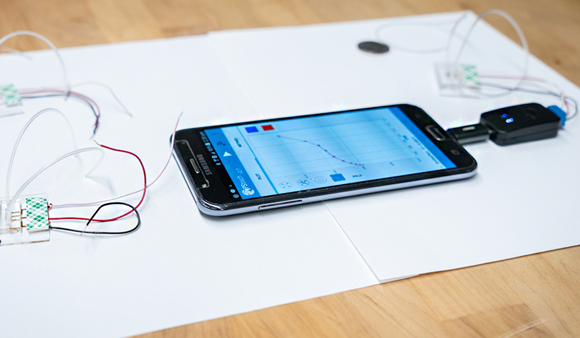
The sensor was developed by a team lead by Rahul Panat, Associate Professor of Mechanical Engineering at Carnegie Mellon University, who researches Additive Manufacturing techniques for producing biosensing devices and human-computer interfaces. Prof Panat also collaborated with Shou-Jiang Gao, leader of the Cancer Virology Program at UPMC Hillman Cancer Center and professor of microbiology and molecular genetics at the University of Pittsburgh.
“My research team was working on 3D printed high-performance sensors to detect dopamine, a chemical in the brain, when we realised that we could adapt our work for COVID-19 testing,” stated Prof Panat “We shifted our research to apply our expertise to combatting this devastating pandemic. The Aerosol Jet process was critical to producing a sensor with high sensitivity and speed.”
The sensor has entered trials with COVID-19 patients and could prove to be a key tool in understanding the path and concentration of the current COVID-19 pandemic and could be a critical enabler in opening up certain parts of the economy. According to the researchers, the device has the potential to detect other viruses such as Zika, Ebola and HIV.