University of Maine develops technique to separate cross-contaminated metal powders
Researchers at the University of Maine, USA, have developed a technique to separate cross-contaminated metal powders without the need for melting and reprocessing. The process could recover materials for reuse in Additive Manufacturing, sintering and other powder-based manufacturing processes, helping to reduce waste.
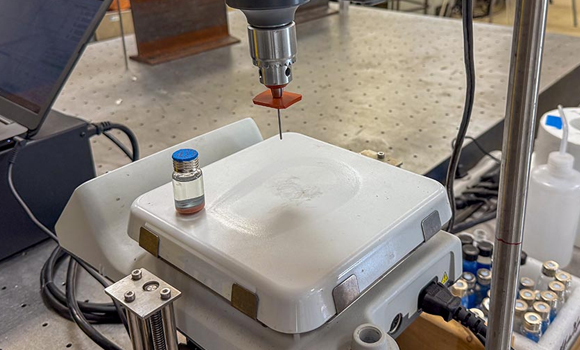
The technique, called shear-assisted particle entrapment (SHAPE), separates microscopic metal particles and captures them in a polymer film. In a recent study published in Powder Technology, researchers tested the process using aluminium and copper powders mixed in a liquid and placed in a spinning machine.
“We’re trying to solve a significant materials-loss problem that occurs during the production of high-value components and products across critical sectors, such as aerospace, energy storage, tooling, biomedical devices and electronics,” said lead researcher Bashir Khoda, associate professor of mechanical engineering at the University of Maine. “It is also an ongoing challenge for strengthening ‘Made in USA’ manufacturing, where uncertainty in the supply chain for critical minerals can affect cost, availability, and production resilience.”
“Our longer-term objective is not simply to separate particles in the laboratory, but to develop a scalable and AI-driven manufacturing system that could recover cross-contaminated powders and return usable material to the Additive Manufacturing supply chain and beyond,” continued Khoda.
Khoda, who is also an associate faculty member with the Advanced Structures and Composites Center (ASCC), devised the particle entrapment method in collaboration with William Gramlich, associate professor of chemistry and associate faculty member with the ASCC; Khalid Jawed, an associate professor of mechanical engineering at the University of California, Los Angeles; and graduate student researchers Ibrahim Khalil, Adeeb Alam and Md. Akibul Islam.
The researchers investigated the separation of aluminium and copper particles measuring up to 25 µm in diameter, using a liquid carrier and rotational speeds of 200–1,500 rpm.
The composition of the captured material varied with rotational speed. At the lowest speed tested, approximately 87% of the particles trapped on the substrate were aluminium. At 1,500 rpm, copper accounted for around 90%, demonstrating how changes in processing conditions can favour the capture of different metals.
Although the researchers achieved high particle-level selectivity, the overall amount of material captured from the starting mixture remained relatively low under laboratory conditions.
“The current study demonstrates the selectivity of the mechanism, rather than an industrially ready recovery process. The next challenge is to maintain this selectivity while substantially increasing the amount of material that can be processed and recovered,” Khoda added.
Future research will examine ways to increase the amount of material processed while maintaining selective separation, including changes to substrate size and geometry, particle loading, polymer concentration and processing time, as well as the use of multiple substrates and continuous or multistage operation. The team also plans to investigate particle transport and retention, test additional material combinations and assess whether recovered powders retain the chemistry, morphology, flowability and manufacturing performance required for reuse.