Formnext Awards 2026 recognise FlexCycle and TU Darmstadt for metal AM innovation
The winners of the Formnext Awards 2026 have been announced. Recognising achievements across six categories in Additive Manufacturing, metal Additive Manufacturing was represented in two winners: FlexCycle Solutions (Sustainability Award, supported by Renishaw) and Dr Michael Kraemer of TU Darmstadt (AMbassador Award).
AMbassador Award
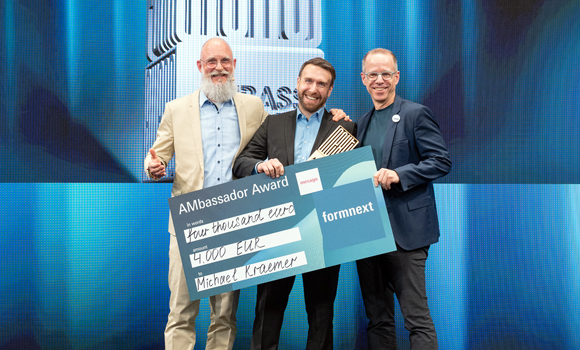
Dr Michael Kraemer, managing director of the Additive Manufacturing Center (AMC) at TU Darmstadt, Germany, received the Formnext 2026 AMbassador Award in recognition of his commitment to Additive Manufacturing education and workforce development.
Kraemer studied materials science at TU Darmstadt and completed his doctorate in 2018, researching crack growth in nickel-based cast alloys under thermomechanical fatigue conditions. He joined the university’s Institute for Materials Technology (IfW) as a researcher in 2012, specialising in the mechanical behaviour and service life of high-temperature materials. His work has included collaborative research with industrial partners in the gas turbine sector, including Siemens Energy, MTU and Rolls-Royce.
Alongside his research, Kraemer has taken on responsibility for coordinating Additive Manufacturing activities across TU Darmstadt. His current research focuses on process–microstructure–property relationships in metal AM materials and predicting their mechanical behaviour at elevated temperatures.
The AMC is an open learning, research and technology transfer hub dedicated to making Additive Manufacturing more accessible, understandable and applicable. With a particular focus on metal powder processes, the centre covers the complete physical AM process chain, from alloy development and ultrasonic powder atomisation to Laser Beam Powder Bed Fusion of Metals (PBF-LB/M), high-speed Directed Energy Deposition (DED), post-processing and quality assessment, including mechanical testing, materials analysis and CT scanning.
Bringing together expertise from 13 institutes spanning mechanical engineering, materials science and civil engineering, the AMC provides an interdisciplinary environment in which researchers, students, technicians, start-ups and established companies can learn, experiment and develop new solutions.
Education and workforce development are central to the AMC’s activities. Each year, 50–60 students complete its courses and more than 20 student projects are undertaken in its laboratories. Its research has also contributed to ten PhD theses over three years. In collaboration with industry organisations, the centre introduces more than 40 technical apprentices to AM and provides training to over 50 engineers and technicians. Open laboratory days and guided tours attract a further 200–300 visitors annually.
The AMC also works to support SMEs, start-ups and public organisations through feasibility assessments, design support and access to industrial AM equipment before investment decisions are made. Partnerships with VDMA, HessenMetall and Hessen Trade & Invest further support knowledge transfer and the development of AM capabilities across the Frankfurt-Darmstadt region and beyond. Through these activities, the centre aims to develop the skills, knowledge and responsible practices needed to help new users adopt AM and translate ideas into practical applications.
Sustainability Award, supported by Renishaw
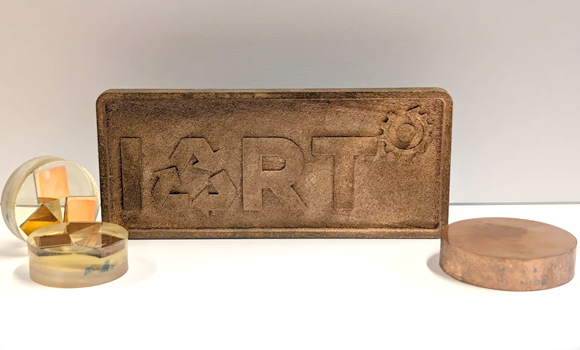
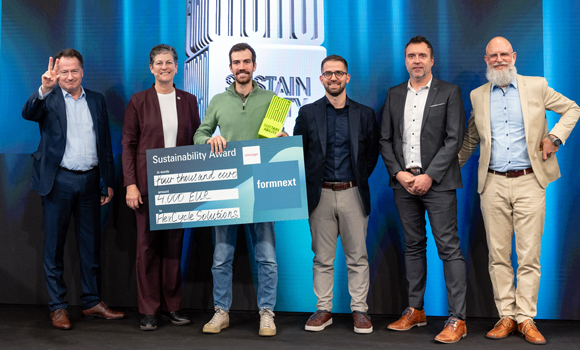
FlexCycle Solutions, Freiberg, Germany, was awarded for its mechanical process which converts copper production scrap and electronic waste into recycled copper powder for Additive Manufacturing and Powder Metallurgy, without melting the metal.
According to FlexCycle Solutions, the process operates at temperatures below 100 °C and consumes approximately 650 kWh per tonne of powder, compared with a reported 9,000 kWh per tonne or more for conventional gas atomisation. The process requires no inert gas, chemicals or water, and uses secondary raw materials sourced within Europe.
According to FlexCycle Solutions, the resulting copper powder features a spherical-rough particle morphology that improves infrared laser absorption compared with conventional atomised powders, supporting copper processing using Laser Beam Powder Bed Fusion. In conventional press-and-sinter PM applications, the rough particle surfaces are also reported to improve green strength, potentially reducing rejection rates. The company produces powder fractions of 20–63 µm and 63–100 µm.
FlexCycle Solutions is a planned spin-off from the Institute of Mineral Processing Machines and Recycling Systems Technology (IART) at TU Bergakademie Freiberg, supported by the EXIST-Forschungstransfer programme.
Complete winners list
- Michael Kraemer of TU Darmstadt – AMbassador Award
- Maya Kaplan – Design Award
- Thought3D – (R)Evolution Award
- cAIclone – Rookie Award
- sallea – Start-up Award
- FlexCycle Solutions – Sustainability Award, supported by Renishaw
The winners were selected through a combination of jury evaluation and public voting, with visitors able to vote online and at the event. Each winner received an additively manufactured trophy designed by Sutosuto and produced by FKM Sintertechnik, alongside prizes supported by Renishaw and the Fomas Group.