Dyndrite selected for America Makes Delta Qual 2.0
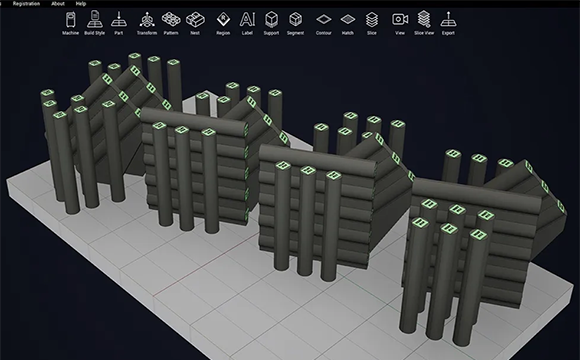
Dyndrite, based in Seattle, Washington, has been selected to participate in two funded technical projects under the America Makes Delta Qual 2.0 programme, a $9 million initiative focused on modernising qualification methodologies for metal Additive Manufacturing.
Delta Qual 2.0 addresses some of the industry’s most significant barriers to the widespread adoption of AM for production by reducing qualification costs, improving machine-to-machine consistency, and enabling more flexible manufacturing workflows for Laser Beam Powder Bed Fusion (PBF-LB). The programme supports the US Department of Defense’s objectives to deploy reliable, scalable, and cost-effective advanced manufacturing capabilities throughout the Defense Industrial Base (DIB) and Organic Industrial Base (OIB).

Dyndrite will participate in projects supporting both:
- Topic 1 – Quantitative Measurement-Based Installation Qualification, which seeks to establish enhanced measurement, calibration, and maintenance procedures that create robust machine performance baselines capable of supporting event-based requalification with little to no mechanical testing.
- Topic 2 – Bracketed Qualification for LPBF, which seeks to establish qualification frameworks that define acceptable process boundaries, allowing manufacturers to vary processing parameters and deploy advanced, feature-based toolpath strategies without requiring full requalification.
“At Dyndrite, we’ve come to call a bracketed delta qualification approach ‘SASSQUATCH’ — Software Adapted Scan Strategy Qualification Assisting Thermal Control and Homogeneity — the elusive software-defined scan strategy derived from a qualified process window that helps ensure optimal part quality,” said Harshil Goel, CEO and founder of Dyndrite. “For Additive Manufacturing to reach its full potential, qualification must evolve beyond today’s static parameter sets. Delta Qual 2.0 represents an important step toward replacing uncertainty with quantitative measurement, validated process windows, digital process definitions, and traceable workflows. We’re excited to work alongside America’s leading defence organisations, machine manufacturers, and research institutions to help modernise qualification for the next era of Additive Manufacturing.”
Dyndrite states that its LPBF Pro software platform enables manufacturers to generate deterministic toolpaths, implement feature-based process strategies, maintain complete digital traceability, and deploy consistent manufacturing workflows across multiple machine platforms. According to Dyndrite, these capabilities support a number of the technical objectives being explored through the Delta Qual 2.0 programme, including process portability, machine equivalency, and scalable qualification methodologies.
The funded projects bring together government, industry and academic partners such as EOS North America, Inc., Phase3D, Laboratory Testing (LTI), Lockheed Martin, L3Harris Technologies, Fluor Marine Propulsion, RTX Technology Research Center (RTRC), Oerlikon, Velo3D, Northrop Grumman, Nikon SLM, Air Force Research Laboratory (AFRL), RTX (Raytheon), Auburn University and others to develop practical qualification approaches that reduce technical and industrial risk while accelerating the adoption of advanced manufacturing technologies for mission-critical applications.
By helping establish new qualification frameworks that build manufacturing confidence while enabling advanced manufacturing capabilities, the Delta Qual 2.0 programme aims to accelerate the transition of PBF-LB technologies into qualified production across defence and commercial applications.
Dyndrite will participate in technical presentations, announce the winner of its Student Competition and host interactive workshops at ICAM 2026, scheduled to take place from September 28-October 2, 2026. Those interested in attending can register here.