NASA selects Phase3D for Born Qualified Additive Manufacturing project
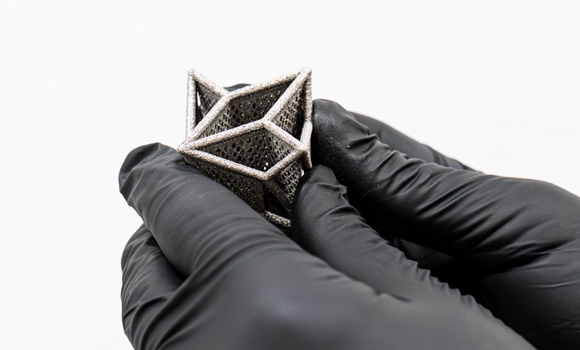
Phase3D, based in Chicago, Illinois, USA, has announced that it has received a major contract award from NASA to advance the agency’s “born qualified” manufacturing vision for spaceflight hardware. Under the programme, Phase3D will partner with a confidential US aerospace prime and space propulsion manufacturer to deploy its Fringe Inspection and Fringe Qualification systems on a large-format, quad-laser EOS M300-4 metal Additive Manufacturing machine.

The contract addresses one of NASA’s most pressing manufacturing challenges: how to qualify additively manufactured components for spaceflight quickly, repeatably, and at scale. Qualifying a single metal AM part for flight today can take more than 18 months, with rejection rates reportedly reaching as high as 30% across the industry. Phase3D’s technology replaces costly post-process CT scans and destructive testing with real-time inspection during the build itself, catching defects layer by layer and producing calibrated, traceable data aligned with NASA-STD-6030, NASA-STD-6033, and SAE AMS7032.
Fringe Inspection uses structured-light scanning to generate calibrated, repeatable 3D heightmaps of every powder and melted layer in a metal AM build. The system detects defects that have historically remained hidden until destructive testing, including powder anomalies, recoater blade collisions, melt-pool irregularities, layer shifts, spatter buildup, and delamination. Its enterprise companion, Fringe Qualification, aggregates that data into a quality-assurance platform that supports machine-agnostic qualification workflows across materials, machines, and facilities.
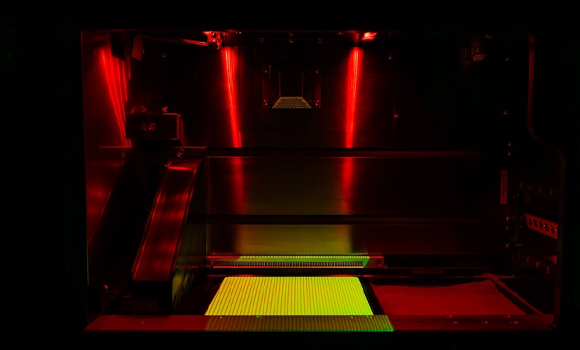
The NASA project will see Phase3D’s system adapted to one of the largest and fastest production-class metal AM machines in the world, the quad-laser EOS M300-4, and applied to topology-optimised Invar 36 brackets representative of structural spaceflight hardware. Over the course of the programme, Phase3D will install Fringe Inspection and capture more than 50,000 layers of in-situ inspection data across production-scale builds, correlate that data with post-build CT scans, and define quantitative go/no-go thresholds that NASA, its primes, and its suppliers can use to certify AM parts in real time.
Dr Niall O’Dowd, Founder and CEO, Phase3D, said, “For decades, qualifying a 3D-printed part for spaceflight has meant months of destructive testing and CT scanning, an approach that does not scale. With Fringe Inspection, the part is qualified as it is built. Every powder layer, every weld, every anomaly is captured in calibrated, defensible data. That is the foundation the industry needs to unlock Additive Manufacturing at scale, not only for NASA, but for every aerospace, defence, and energy programme building flight-critical hardware.”

The programme directly addresses NASA Civil Space Shortfalls 1490 through 1494, which call for deployable, real-time tools for in-situ process monitoring, process qualification, part qualification, and qualification of complex geometries. Phase3D’s prior validation work at NASA Marshall Space Flight Center demonstrated high correlation between CT-scanned porosity and layer-wise data from Fringe Inspection data via a simple threshold classifier. Parallel studies with the US Air Force Research Laboratory showed that layer-wise anomalies flagged by Fringe Inspection correlated with CT-detected defects in finished parts.
By validating parts during the build instead of after, the technology is projected to reduce qualification costs significantly and accelerate qualification timelines by two-to-three times, delivering structural, propulsion, and thermal-management hardware faster for NASA missions, and which the company states could enable a new economic model where every additively manufactured part arrives with a quantitative, auditable record of its quality.
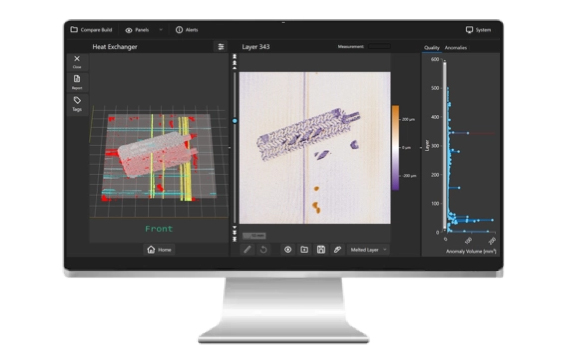
Fringe Inspection is deployed as a retrofit and built-in quality inspection product at commercial and government sites worldwide, however, the new NASA programme extends that footprint onto one of the largest production-class metal AM systems and into one of the most demanding qualification environments in industry.
“Real-time inspection is the missing piece in the Additive Manufacturing ecosystem,” said Dr O’Dowd. “Powders, lasers, machines, and process parameters have all matured. What has been missing is a way to prove, in real time, that the part you built is the part you designed, on every layer, every time. That is what Fringe Inspection delivers, and that is what makes large-scale, mission-critical Additive Manufacturing possible.”
Deployment will take place at the confidential US aerospace prime’s Additive Manufacturing Center of Excellence, where demonstration and data collection activities will be conducted.