EPFL develops hydrogel AM method for dense metal parts
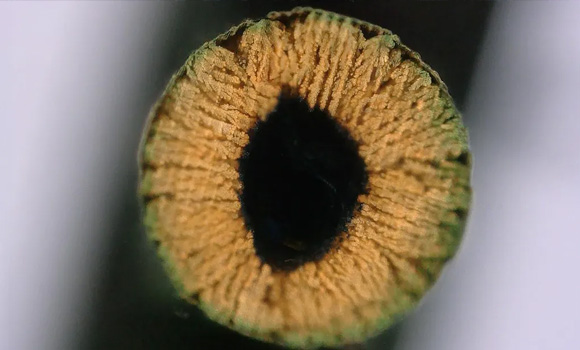
Researchers from the Swiss Federal Technology Institute of Lausanne (EPFL), Switzerland, have developed an Additive Manufacturing method that ‘grows’ metals and ceramics inside a water-based gel. The resultant material is said to be exceptionally dense with intricate constructions, making it suitable for next-generation energy, biomedical and sensing technologies.
Vat Photopolymerization is an Additive Manufacturing technique in which a light-sensitive resin is poured into a vat and selectively hardened into a desired shape using a laser or UV light. However, this process is mostly used only with light-sensitive polymers, which limits its range of applications.
While some Additive Manufacturing methods have been developed to convert these AM polymers into tougher metals and ceramics, the materials tend to be porous, thus reducing strength, and resultant parts may undergo excessive shrinkage.
Led by Daryl Yee, head of the Laboratory for the Chemistry of Materials and Manufacturing in EPFL’s School of Engineering, the research team published a paper in Advanced Materials that focused on the new Additive Manufacturing technique. Rather than using a light to harden a resin pre-infused with metal precursors, the EPFL team created a 3D scaffold from a hydrogel. This ‘blank’ hydrogel is then infused with metal salts that are converted into metal-containing nanoparticles that permeate the structure. This is a repeatable process that enables the production of composites with very high metal concentrations.
After five to ten ‘growth cycles’, a final heating step burns away the remaining hydrogel, leaving behind the finished product: a dense, strong metal or ceramic object in the shape of the original blank polymer. Since the hydrogels are only infused with the metal salts after fabrication, the technique allows a single hydrogel to be transformed into multiple different composites, ceramics, or metals.
“Our work not only enables the fabrication of high-quality metals and ceramics with an accessible, low-cost 3D printing process. It also highlights a new paradigm in Additive Manufacturing where material selection occurs after 3D printing, rather than before,” Daryl Yee explained.
Targeting advanced 3D architectures
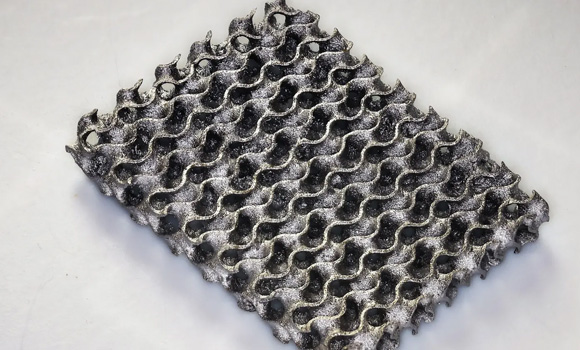
For their study, the team fabricated intricate mathematical lattice shapes (’gyroids’) out of iron, silver, and copper, demonstrating the technique’s ability to produce strong yet complex structures. To test the strength of their materials, the researchers used a device called a universal testing machine to apply increasing pressure to the gyroids.
“Our materials could withstand 20x more pressure compared to those produced with previous methods, while exhibiting only 20% shrinkage versus 60-90%,” stated Yiming Ji, first author and PhD student.
According to the scientists, the newly developed technique may be particularly useful when manufacturing advanced 3D architectures that must be strong, lightweight and complex (e.g., sensors, biomedical devices, high-surface-area metals for energy technologies, and metal catalysts essential for enabling reactions that convert chemical energy into electricity).
Looking ahead, the EPFL scientists are working on improving their process to facilitate industry uptake by increasing the density of the resultant materials. Another goal targeted by the team is speed; the repeated infusion steps, while essential for producing stronger materials, make the method more time-consuming compared to other Additive Manufacturing techniques for converting polymers to metals.
“We are already working on bringing the total processing time down by using a robot to automate these steps,” Yee stated.
‘Hydrogel-Based Vat Photopolymerization of Ceramics and Metals with Low Shrinkages via Repeated Infusion Precipitation’ is available here, in full.
www.epfl.ch