IMDEA outlines microstructure control for additively manufactured Ni superalloys

Researchers from IMDEA Materials Institute have developed a streamlined and industrially scalable methodology to design and control microstructure in nickel-based superalloys manufactured by Laser Beam Powder Bed Fusion (PBF-LB).
Specifically, the authors of the new study, recently published in the Additive Manufacturing journal, present empirical and analytical approaches for microstructural control during PBF-LB of the Inconel 939 (IN 939) alloy over a relatively wide range of processing conditions.

Author Ignacio Rodríguez Barber, PhD researcher at the Sustainable Metallurgy Group at IMDEA Materials, led by María Teresa Pérez-Prado, shared, “This study shows it is possible to locally predict and control the microstructure in a simple and efficient manner.”
Key to the paper’s findings is the identification of melt pool overlap, a geometric parameter related to the spacing of the laser scan tracks, as a reliable predictor and design tool to control grain structure during the fabrication of IN939, a high-performance alloy widely used in aerospace and energy applications.
In this regard, the researchers show that microstructure, specifically grain shape, size, and orientation, can be locally modified by adjusting the melt pool overlap perpendicular to both the scan direction and the build direction.
Processing conditions that produce melt pool overlaps below 0.6 help prevent the development of strongly oriented, elongated grains, promoting a more uniform and fine-grained structure. Conversely, higher overlaps encourage the grains to grow in a columnar manner, creating a strongly textured internal structure.
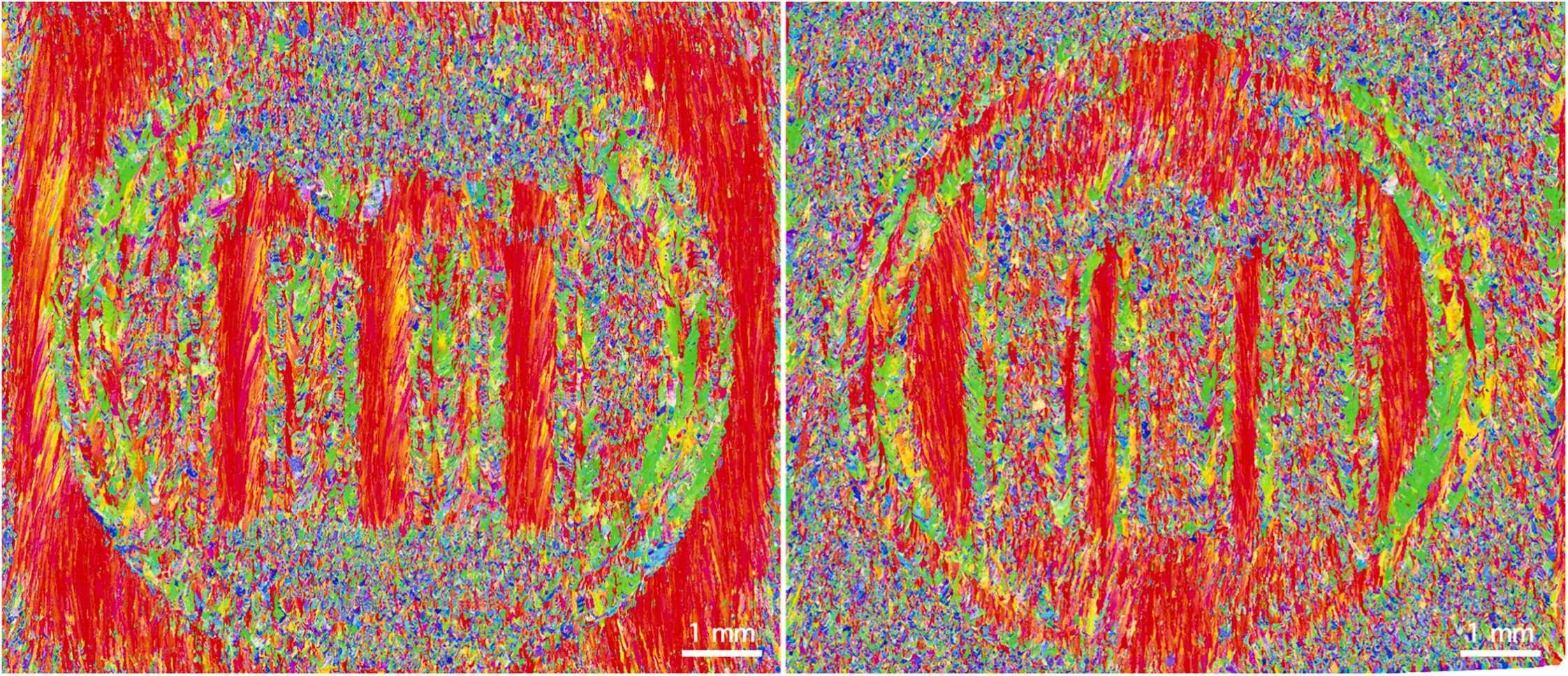
The authors combine multitrack experiments with an analytical model based on a reformulated Rosenthal equation and a modified normalised volumetric energy density.
This combination results in a predictive tool that allows manufacturers to accurately tune the microstructure based on key parameters like laser power, scan speed, hatch distance, and scan track length.
Rodríguez Barber stated, “IN939 is of high interest in demanding engineering applications like gas turbines and the aeronautical industry because of its excellent combination of high-temperature strength, oxidation resistance, and creep resistance.”
“However, it is also difficult to process due to its cracking susceptibility, resulting in a narrow processability window. Our approach not only provides guidelines to obtain excellent printing results, it also enables site-specific design of microstructure for different sections of a part, paving the way for performance-optimised components,” Barber added.
The methodology is compatible with high-productivity scanning strategies typically used in industry, including large layer thicknesses, fast scan speeds, and standard meander patterns with 67° rotation between layers.
This work builds on IMDEA Materials’ track record in processing and characterising advanced metallic alloys and is a clear example of how fundamental materials science can offer practical solutions to Additive Manufacturing challenges.
The complete paper, ‘Melt pool overlap as a key tool for microstructure design in PBF-LB/M of a Ni-based superalloy: Empirical and analytical approaches’ is available here.
materials.imdea.org