UKAEA commissions Freemelt and Nikon SLM machines for fusion component production
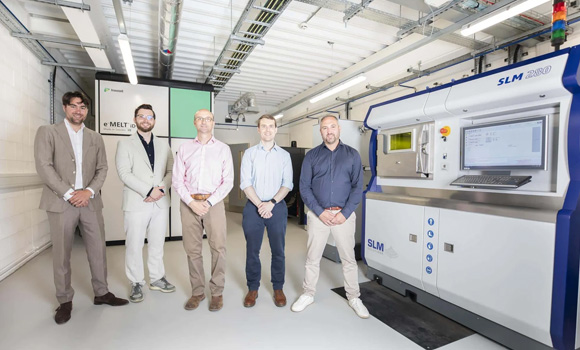
The United Kingdom Atomic Energy Authority (UKAEA) reports it has adopted two Additive Manufacturing technologies to manufacture components for fusion machines at its recently opened Central Support Facility (CSF). It now operates both Electron Beam Powder Bed Fusion (PBF-EB) and Laser Beam Powder Bed Fusion (PBF-LB) Additive Manufacturing machines at the site.
The UKAEA commissioned an eMELT PBF-EB machine from Freemelt AB, based in Mölndal, Sweden. It will mainly be used to manufacture tungsten components, where it will layer tungsten onto other materials such as copper chrome zirconium, stainless steel and Eurofer 97, a special type of steel developed for use in fusion machines.
The SLM280 PBF-LB machine is from Nikon SLM Solutions, headquartered in Lübeck, Germany. It was provided by Kingsbury Machine Tools and supported by Additure. This AM machine will be used to explore methods for producing components with the complex geometries and material combinations that are believed to be essential for successful fusion plants.
Both AM technologies will support the manufacture of plasma-facing components that will be exposed to extreme temperatures during their operational lifecycle. The machines will also reduce the reliance on traditional techniques such as welding, reducing the number of manufacturing operations and joining processes.
Fusion is expected to play a key role in a global low-carbon energy future. However, the components within future fusion power plants will have to operate under complex and challenging conditions, including extreme temperatures, high neutron loads, and strong magnetic fields. As a result, they require complex combinations of materials and precision engineering.
Additive Manufacturing is well suited to producing materials with intricate designs, and in low volumes, making it ideal for a sector such as fusion, where, for the near future, each fusion machine will be highly individual and require bespoke components. As a result, UKAEA believes that Additive Manufacturing can play an important role in the future of fusion, reducing the costs of this precision manufacturing and has commissioned the machines to demonstrate two complementary AM methods to produce fusion components.
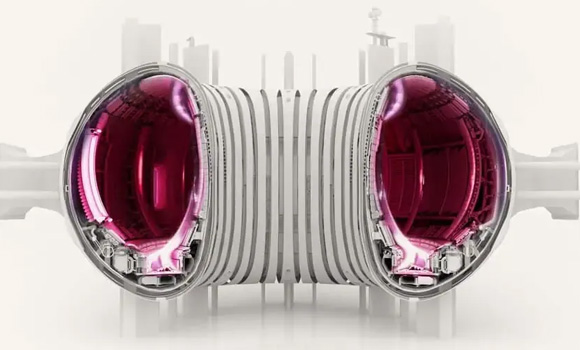
“Future fusion power plants will require thousands – or even millions – of components with complex geometries that can withstand the extreme conditions of a fusion environment,” stated Roy Marshall, Head of Operations for Fabrication, Installation and Maintenance, at UKAEA. “UKAEA believes that Additive Manufacturing will be essential to developing these components at a scale that makes fusion commercially viable. We have commissioned two complementary Additive Manufacturing machines so we can demonstrate that fusion components can be printed at a production scale, enabling the fusion industry to develop components at our facilities that would otherwise be commercially prohibitive.”
“Using these machines will enable parts and geometries to be produced more efficiently than by using traditional fabrication methods,” Marshall continued. “Many companies will have either an electron beam machine or selective laser melting technology but having both capabilities under one roof – and able to produce components at scale – is a first for the fusion industry.”
The CSF brings together technology with purpose-built workshops into one building, alongside UKAEA’s Manufacturing Support Team and Special Techniques Group, to enable collaboration between manufacturing teams and to support fusion research and development. UKAEA is now working to prepare commercial partners for the large-scale production believed to be essential for the fusion energy plants of the future.
Viktor Valk, Regional Manager, EMEA at Freemelt commented, “We are honoured to support UKAEA in their important work to advance fusion energy as a commercially viable energy source. The use of Freemelt’s industrial machine eMELT to produce tungsten plasma-facing components exposed to extreme conditions in fusion energy machines, marks an important step in applying our E-PBF technology to fusion energy development.”
Christoph Barefoot, Regional Business Director UK & Nordics, Nikon SLM Solutions added, “Fusion represents the future of energy – but it can only be realised through bold innovation and trusted collaboration. At Nikon SLM Solutions, we are proud to support UKAEA’s mission with our industry-leading Selective Laser Melting technology, helping make complex, high-performance fusion components not just possible, but scalable. With this milestone, we move one step closer to commercial fusion – and a more sustainable tomorrow.”
Both machines will now start the work of producing challenging geometries and undertake experiments exploring the properties of additively manufactured materials. This work will be followed by initial stages of manufacturing involving tungsten and copper chrome zirconium layering.
www.freemelt.com
www.nikon-slm-solutions.com