Woven Nitinol architectures improve superelastic performance in Additive Manufacturing
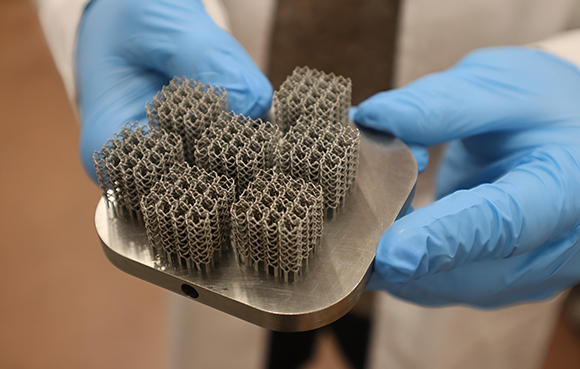
Researchers from IMDEA Materials Institute and the Technical University of Madrid (UPM), Spain, have manufactured nickel-titanium (Nitinol) alloys as a deformable, interwoven material, reportedly more similar to fabric than to a metal component.

In a recent study, researchers increased the deformability of woven superelastic nitinol metamaterials. The team has said that their results, published in Virtual and Physical Prototyping, may hold promise for the development of high-performance actuators in robotics, aerospace and healthcare.
Nickel–titanium alloys are known for their superelasticity and shape-memory behaviour. Their compatibility with advanced Additive Manufacturing technologies, however, has been limited. Typically, when processed by AM techniques such as Laser Beam Powder Bed Fusion (PBF-LB), nitinol exhibits reduced elasticity and recoverable strain compared with conventionally manufactured nitinol materials.
Carlos Aguilar Vega, researcher from IMDEA Materials and the UPM, and one of the authors behind the recent publication, shared, “While LPBF remains the gold standard of nitinol Additive Manufacturing, the shape-memory and superelastic properties of these additively manufactured NiTi parts do not yet match those achieved with more conventional industrial processes.”
“Effectively, this means that we have so far been unable to harness the enhanced control of mechanical performance by design, or the geometrical complexity offered by 3D printing techniques in the Additive Manufacturing of nitinol structures,” he added.
Previous studies have shown that the deformability rate of additively manufactured nitinol samples is roughly half that of industrial nitinol produced via traditional processes, with additively processed powders promoting increased brittleness.

To address this challenge, the study’s researchers adopted a design-centred approach, shifting the focus from material optimisation to architected structures intended to amplify mechanical performance through geometry. They also placed particular focus on highly deformable, woven structures, including meshes, spheres and rings.
Fellow author, Prof Andrés Díaz Lantada from the UPM and IMDEA Materials Institute, stated, “These were some of the most complex-shaped woven nitinol structures ever created. Promisingly, they represent a breakthrough in the Additive Manufacturing of superelastic alloys and demonstrate the possibility of achieving self-supported NiTi wovens via LPBF techniques.”
The study introduces a novel algorithm-based design framework for creating highly deformable interwoven metamaterials, specifically tailored for the Additive Manufacturing of nitinol. Using this approach, the team developed and manufactured two structure families: tubular lattices and cylindrical woven architectures.
Both design families were successfully manufactured in superelastic nitinol and systematically characterised. Mechanical testing was said to have revealed that, by design alone, the stiffness, load-bearing capacity, energy absorption and toughness of these structures can be modulated across several orders of magnitude.
To ensure compatibility with Additive Manufacturing and structural fidelity, the team combined computed tomography of the additively manufactured samples with digital models generated by AM slicer software, enabling a detailed comparison between designed and manufactured geometries.
The multi-scale validation is said to indicate the robustness of the proposed methodology and its suitability for complex, customisable architectures.
Aguilar Vega concluded, “This work represents the first demonstration of design-based optimisation of additively manufactured superelastic nitinol, showing that mechanical drawbacks inherent to current Additive Manufacturing processes can be effectively mitigated through architecture.”
Fellow researchers behind the breakthrough include IMDEA Materials’ Óscar Contreras, Dr Muzi Li, Dr Vanesa Martínez, Amalia San Román and Prof Jon Molina, in collaboration with the UPM’s Rodrigo Zapata Martínez.
The full paper is available to read here.