WC-Co cemented carbide Additive Manufacturing achieves >1,400 HV using hot-wire laser DED
Japanese researchers from Hiroshima University, Higashi-Hiroshima, and Mitsubishi Materials Hardmetal Corporation, Gifu, have reported the successful Additive Manufacturing of tungsten carbide–cobalt (WC-Co) cemented carbide in the International Journal of Refractory Metals and Hard Materials.
The study aimed to produce dense WC-Co cemented carbide while suppressing porosity caused by WC decomposition during processing. To achieve this, the researchers used Directed Energy Deposition (DED) Additive Manufacturing using a hot-wire laser Directed Energy Deposition (DED) process with sintered rod-shaped WC-16%Co feedstock.
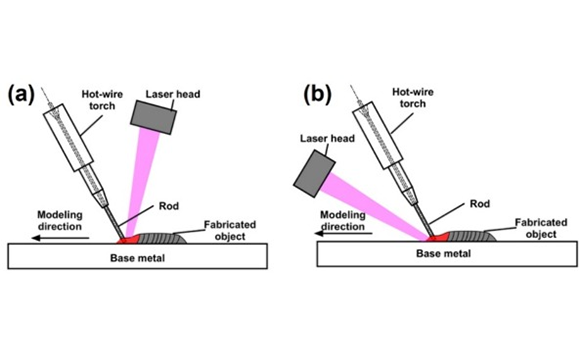
To evaluate the influence of laser irradiation strategy, the researchers compared two fabrication approaches:
- Rod-leading configuration: the laser directly irradiated the top surface of the WC-Co rod.
- Laser-leading configuration: the laser irradiated the region between the base material and the advancing rod.
In the rod-leading configuration, WC decomposition occurred in the directly irradiated region, resulting in significant defects. In the laser-leading configuration, WC decomposition was suppressed; however, iron (Fe) from the base material diffused into the deposit, reducing hardness. Introducing a Ni-based alloy interlayer limited Fe diffusion and produced WC-Co cemented carbide with hardness exceeding 1,400 HV, without decomposition or observable defects.
‘Effect of the hot-wire laser irradiation method and a Ni-based alloy middle layer on mechanical properties and microstructure in additive manufacturing of WC–Co cemented carbide’ is available here.