US Army looks beyond polymer AM towards metal WAAM
The US Army is exploring how Additive Manufacturing could strengthen battlefield sustainment capabilities, with plans to explore the technology beyond polymer-based machines towards metal AM technologies such as Wire Arc Additive Manufacturing (WAAM), a form of Directed Energy Deposition (DED).
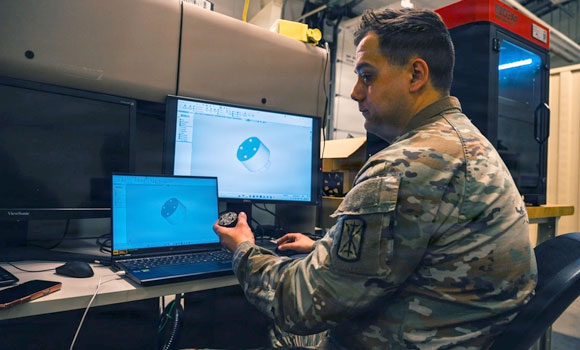
At a recent Additive Manufacturing symposium hosted by the 1st Special Forces Group (Airborne), soldiers received hands-on training in design software, AM workflows and part production, as the Army evaluates how distributed manufacturing could support maintenance, training and operational readiness.

Sgt Clarissa De La Cruz, a 91E Allied Trade Specialist, explained that the Army’s growing interest in Additive Manufacturing is tied to broader efforts to improve self-sufficiency in expeditionary environments. “The Army is starting to be more innovative… to see how much we can really fully sustain ourselves. Additive Manufacturing gives us more opportunity to create parts and do our job.”
The symposium introduced participants to the fundamentals of the AM process chain, beginning with computer-aided design (CAD) and progressing through slicing software and print parameter optimisation. Soldiers used SolidWorks to design components before preparing builds in PrusaSlicer, adjusting variables including temperature, layer structure and print density.
While much of the current activity remains focused on polymer-based Material Extrusion (MEX) Additive Manufacturing, the longer-term objective is to expand into metal AM applications capable of producing more durable end-use components.
At unit level, the Army is already using polymer AM systems to manufacture training aids, radio caps, equipment modifications and decoys. One example highlighted during the symposium was a full-scale M777 155 mm howitzer muzzle produced as a training decoy. De La Cruz explained that the technology’s immediate value lies in reducing lead times for low-cost replacement parts and enabling rapid iteration during field maintenance.
“It just allows more accessible, quick solutions,” she explained. “It’s all made in-house, so it’s a lot less money that we’re spending.”
Despite the growing interest in AM, challenges remain around software access, training requirements, machine availability and programme funding. De La Cruz noted that software licensing costs and leadership understanding of the technology continue to influence adoption rates across units.
Still, the symposium was said to have reflected a wider shift in how the US Army views digital manufacturing as a future sustainment capability that could eventually incorporate metal AM for deployed repair and replacement part production.
“The possibilities are endless with what Additive Manufacturing can do,” stated De La Cruz. “It’s really important for our soldiers to get out there and start learning about what we can do.”