Ursa Major starts work on solid rocket motor test and qualification site
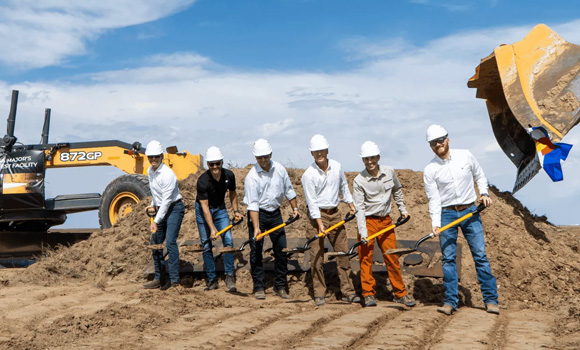
Ursa Major Technologies Inc, headquartered in Berthoud, Colorado, USA, has broken ground on a new 400-acre solid rocket motor (SRM) test site in Weld County, Colorado.

“This facility represents a major step forward in our ability to deliver qualified SRMs that are scalable, flexible, and ready to meet the evolving threat environment,” stated Dan Jablonsky, CEO of Ursa Major. “It’s a clear demonstration of our commitment and ability to rapidly advance and expand the American-made solid rocket motor industrial base that the country needs, ensuring warfighters will have the quality and quantity of SRMs needed to meet mission demands.”
The new site is planned to serve as the test and qualification site for Ursa Major’s large-scale SRMs, supporting current and future missile systems, and accelerating the path to production. Designed for safe, full-scale static firings, and future qualification processes like drop and temperature storage testing, the site enables validation of SRMs built using the company’s Lynx manufacturing process, a software-driven, Additive Manufacturing-enabled production method that supports multiple motor sizes – from 5-56 cm (2-22”) diameters – and thrust profiles without retooling.
This groundbreaking comes on the heels of a high-paced year for Ursa Major’s SRM programme. To date, Ursa Major has conducted four successful SRM flight tests and more than 450 static fires, demonstrating both scale and repeatability across multiple systems. Those included multiple firings of a 13 cm diameter solid rocket motor, validating Ursa Major’s proprietary manufacturing process, multiple 25 cm diameter static fires of a highly loaded grain motor, and a series of static fires for a 7 cm HLG SRM, extending range with the APKWS laser-guided system.
Supported by US Navy investment and an industrial base that, according to the company, requires modernised SRM capability, Ursa Major is scaling production and growing physical test infrastructure to meet the moment and deliver capabilities faster and more affordably than legacy providers.
Work on the site is already underway. Tests are expected to begin at the site in Q4 2025.