University of Arizona team wins $5M US Army grant for hypersonic alloy research
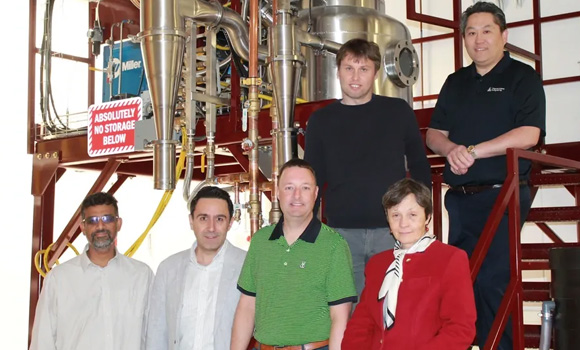
The Mach-X engineering team from the University of Arizona, Tucson, USA, has been awarded a $5 million US Army grant to design an alloy manufacturing process using Additive Manufacturing technology and machine learning to make critical parts for vehicles that fly at least 5x the speed of sound.
The US National Center for Defense Manufacturing and Machining tasked the research team with the creation of an efficient method for producing high-tolerance aircraft parts at reduced costs.

“This grant reflects how the University of Arizona’s well-regarded expertise in hypersonics and materials sciences can bolster the nation’s defense capabilities,” said University of Arizona Senior Vice President for Research and Partnerships Tomás Díaz de la Rubia. “Developing and fostering research partnerships of this kind helps the U of A shape the future and address pressing challenges, and we are excited to see what the Mach-X team designs.”
“We are pioneering metal 3D printing techniques, as well as new and innovative alloys that can support the next generation of affordable hypersonic platforms,” stated Sammy Tin, Patrick R. Taylor Endowed Department Leadership Chair of Materials Science and Engineering, and the grant’s principal investigator.
“These very significant awards are further evidence that the University of Arizona is a leader in hypersonics research,” said David W. Hahn, the Craig M Berge Dean of the College of Engineering. “The funding brings together academia, government and industry to expand research capacities while supporting national priorities in homeland security and technology.”
The Mach-X team – which includes materials science and engineering faculty members Krishna Muralidharan; Oana Cazacu; Andrew Wessman; and Benoit Revil-Baudard, as well as Ron Liang, the Thomas R Brown Endowed Chair in the Wyant College of Optical Sciences; Tribikram Kundu from the Department of Civil, Architectural, and Engineering Mechanics; Kavan Hazeli from the Department of Aerospace and Mechanical Engineering – will partner with Raytheon, an RTX business, to produce prototypes with nickel alloys capable of tolerating the intense heat of hypersonic flight.
“A leading-edge structure or rocket nozzle structure needs to survive at temperatures above 1,100ºC for extended periods and under high stresses,” Tin added.
Additive Manufacturing for prototyping
Tin said the team’s challenge will be to find the right mix of metals and a strong additively manufactured microstructure that can handle hypersonic flight. To achieve this, they will refine the manufacturing process using machine learning and sophisticated nonlinear acoustic detection—a nondestructive process that uses sound waves to test the integrity of AM parts – and use machine learning to create simulations of build formations.
“We can assess the quality of the part as we’re building it and make on-the-spot decisions if we need to go back and update the process,” said Muralidharan.
“We will train the algorithm on the simpler parts and use it to interpret the acoustic responses from the testing process,” Muralidharan said. “That will tell us with a high degree of confidence if there are defects and which structures are working.”
The project employs novel technology in defence manufacturing and aims to accelerate the university’s discovery-to-deployment cycle of advanced materials.
“We can develop the powder, customise the alloy compositions, print in 3D, evaluate the products non-destructively, and ultimately do very high-temperature mechanical testing here,” Tin said. “We will have unique, end-to-end capabilities on campus that very few universities or industrial companies have.”