TU/e secures funding to advance volumetric AM for scalable micro-structure production
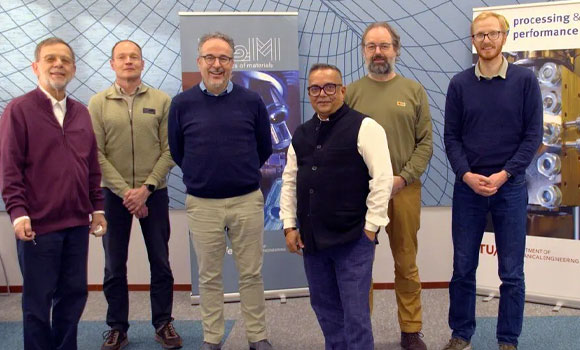
Motion Imager, together with the Mechanics of Materials (MoM) and Processing and Performance (P&P) sections of the Mechanical Engineering department at Eindhoven University of Technology (TU/e), Eindhoven, Netherlands, has secured substantial funding to advance volumetric Additive Manufacturing from a scientific breakthrough into a scalable technology for series production. The project was selected following an evaluation process by the Materials Innovation Institute (M2i) and Holland HighTech. The funded research intends to bring together academic and industrial expertise to bridge the gap between fundamental materials science and manufacturable engineering solutions.
By combining original scientific insights with established knowledge in materials processing and performance, the collaboration aims to deliver reproducible, industrially viable manufacturing methods.

Material discovery and engineering, if conducted without considering the manufacturing process, can lead to scrap, compromised functional range, lower performance yield, high carbon-intensive manufacturing and operation, intractable native material property tunability, and more. The objective of the project is to realise as-manufactured material properties that are aligned with the current as-designed material specifications, thereby ensuring full structural functionality without compromising manufacturability.
The kinds of structures that can be fabricated using volumetric Additive Manufacturing includes the multi-thickness walls of less than tens of a micrometre, multi material composition for different chambers, non-planar shape, with features such as micro-scale surface roughness and internal scaffolds optimised for generative structural design of a micro-thruster for satellites and space shuttles. The manufacturing process gets the team much closer to mimic bio-structures with a Buy-to-Fly ratio closer to 1, significantly reducing waste. In contrast, all other existing traditional manufacturing like casting, molding, forging and printing or layer-based AM result in a Buy-to-Fly ratio of 2 (for basic geometric structures), and for intricate structures with gradient mechanical and complex geometries, this ratio can attain values as high as 20.
The project aims to demonstrate a technological breakthrough in manufacturing complex geometric structures with surface smoothness or roughness at the micron scale and below, including intricate features such as non-planar and hanging structures without the need for fixtures. It targets mechanical properties that are currently inaccessible, while retaining and enhancing functionality through microscale material composition and materials engineering, and achieving reproducibility for series manufacturing. The realisation of this technological breakthrough is said to be crucial to solving existing challenges and enabling new capabilities across a wide range of industries, including automotive, aerospace, space, biomedical, and soft robotics.
The Terra incognita gap between a scientific breakthrough to technological breakthrough requires a joint translational development and demonstrator work between private and academic scientists and engineers. This collaboration is believed to bring all the key pre-requisites and commitment in realising the goal of an initial version of standardised techniques, processes, computational engines and tools, working in a structured and systematic workflow.