Texas A&M investigates metal 3D nanoprinting with hot electrons
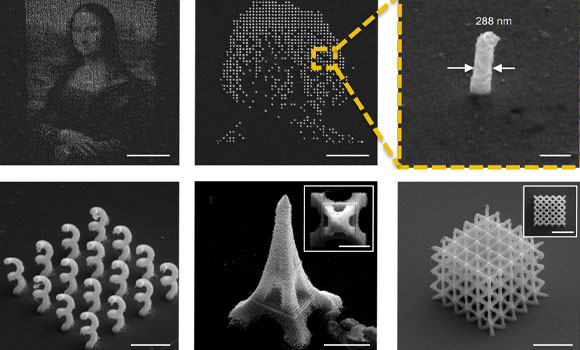
Researchers from Texas A&M University, College Station, Texas, USA, have published a paper in Nature Communications. The paper, titled ‘3D nanoprinting of metals by spatiotemporally confined hot electrons via multiple-electron excitations in nanocrystals’, investigates a method for fabricating complex 3D micro- and nanoscale metal structures.

Multi-photon polymerisation has been a key technology for fabricating complex 3D micro- and nanoscale structures from polymer materials for decades. However, extending this capability beyond polymers remains a significant challenge. Nanoscale metal printing is particularly challenging because solid metal formation typically requires energy-driven reactions or thermally activated processes that are difficult to spatially localise, resulting in compromised feature resolution.
The researchers have demonstrated 3D nanoprinting of metals with depth and lateral resolution less than 250 nm through femtosecond laser-induced hot electrons spatiotemporally confined in nanocrystals to facilitate nonlinear multi-electron absorption, ligand desorption, and nanocrystal fusion.

This approach operates at a pulse energy about 100× lower than simultaneous multi-photon processes, avoids organic additives, and is compatible with free-space or layer-by-layer manufacturing. The researchers demonstrated Additive Manufacturing of multiple metals, reportedly achieving mechanical strength comparable to pure metals, along with functional mechanical and optical metamaterials. According to the researchers, the technology could enable customisable 3D metal nanoprinting for advanced applications in metamaterials, biotechnology, nanorobotics, sensors, and semiconductor manufacturing.
An early-access edition of the paper is available here.