TEMISTh developing ultra-thin heat exchangers using copper Additive Manufacturing
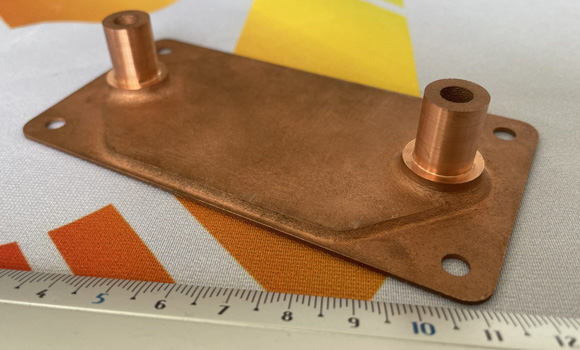
As electronic devices become smaller and their power densities increase, efficient heat dissipation is becoming more important to ensure reliability and performance, explains TEMISTh, based in Lambesc, France. To address these challenges, the company is researching the use of copper Additive Manufacturing to produce custom heat exchangers.
Additive Manufacturing makes it possible to create heat sinks with complex geometries that are impossible to achieve using conventional processes, while maintaining minimal thickness. The technology is paving the way for customised heat exchangers tailored to the specific needs of each application.
The TEMISTh team is focusing on the design of thin copper heat sinks that are adapted to the space constraints of modern power converters. Using advanced numerical simulation tools, the researchers are working to optimise the shape, internal structure, and heat flow distribution to maximise cooling efficiency while limiting hydraulic pressure drop.
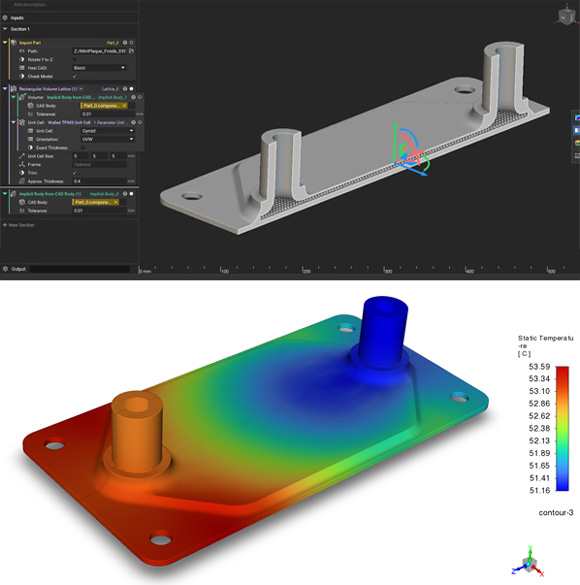
To validate the performance of these new heat sinks, TEMISTh is preparing to launch an experimental testing campaign. This will focus on measuring thermal resistance and pressure drop as a function of heat transfer fluid flow rate. The data collected will then be used to refine simulation models and further optimise the designs.
By combining computer-aided design, thermal simulation, Additive Manufacturing, and experimental characterisation, TEMISTh expects the results will pave the way for more compact, higher-performance devices that are better suited to the demands of future electronics.