Study explores Additive Manufacturing of copper-coated diamond composites
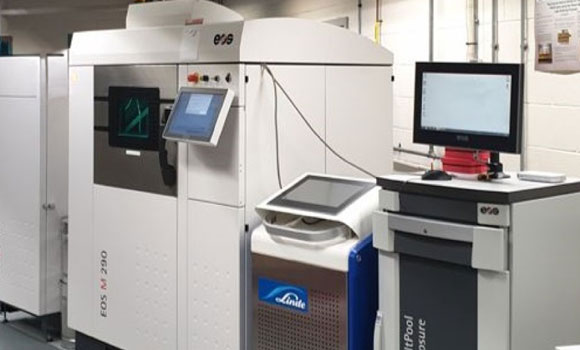
Researchers from the UK’s University of Wolverhampton and Diamond Hard Surfaces Ltd, based in Towcester, as well as the College of Engineering, Prince Mohammad Bin Fahd University, Al-Khobar, Saudi Arabia, have published research in Diamond and Related Materials that demonstrated the processing of copper-coated diamond via Laser Beam Powder Bed Fusion (PBF-LB) Additive Manufacturing.
The study identified a narrow conduction-mode processing window of 150–220 J/mm³, where single tracks reportedly achieved porosity below 2.5% and exhibited predictable geometric behaviour. Outside this range, insufficient energy led to discontinuous melting, while higher energy inputs introduced instability through keyholing and recoil pressure effects.
Through systematic single-track experiments, the researchers developed a process–structure map linking melt-pool geometry, porosity and particle bonding to energy density. This relationship is captured using a vector regression model, offering a unified description of the thermo-fluid behaviour during processing.
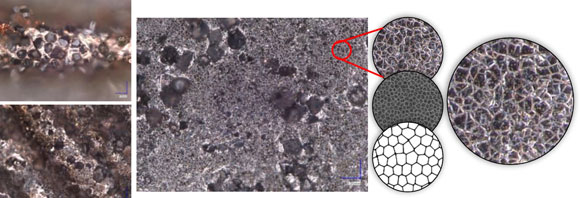
Multi-track experiments revealed six distinct processing regimes, ranging from incomplete melting to fully fused structures and vapour-driven porosity. In particular, the team identified a previously unreported self-organised sub-micron porous lattice forming within a narrow 113–141 J/mm³ energy window. This structure consisted of polygonal networks with pore sizes of 0.5–2 μm and ligament thicknesses of 0.2–0.8 μm, generated through capillary-driven breakup of thin molten copper films between overlapping tracks.
To explain this phenomenon, the researchers developed the Robinson–Arjunan scaling law, combining classical thin-film instability theory with PBF-LB-specific conditions. The model is intended to accurately predict the characteristic spacing of the observed lattice structures, supporting the experimental findings.

The study concluded that the PBF-LB Additive Manufacturing of copper-coated diamond is not solely a consolidation process, but also a mechanism for controlled microstructural self-organisation. By tailoring energy input and feedstock design, the process enables the formation of hierarchical porosity and sub-micron architectures not achievable in monolithic metals, opening new opportunities in the Additive Manufacturing of metal–ceramic composites.
‘Process driven self-organisation in laser powder bed fusion of copper coated diamond’ is available here.