Study examines texture and grain morphology in PBF-LB Inconel 718
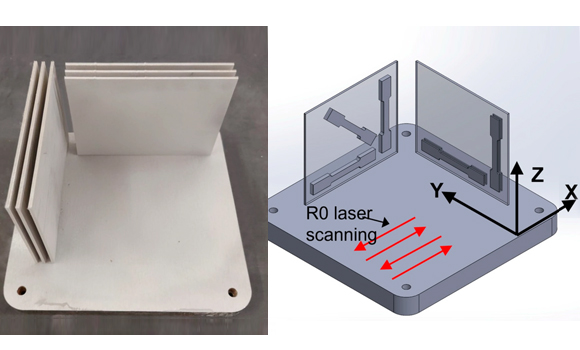
Researchers from Universidad Industrial de Santander (UIS) and Universidad del Norte, both in Colombia, and Advanced Aeronautics Manufacturing Centre CFAA, Spain, have published a study in Journal of Manufacturing and Materials Processing investigating the respective roles of crystallographic texture and grain morphology in the anisotropic mechanical behaviour of Inconel 718 (IN718) produced by Laser Beam Powder Bed Fusion (PBF-LB) Additive Manufacturing.
The researchers compared six representative volume elements (RVEs) using a unified workflow incorporating electron backscatter diffraction (EBSD), DREAM.3D and DAMASK crystal plasticity simulations. The microstructures comprised two EBSD-derived RVEs, two discretised columnar RVEs and two discretised lamellar RVEs, all generated using identical orientation distributions, thereby enabling the effects of texture and grain morphology to be considered separately.

Predicted Young’s moduli and yield strengths were compared with experimental results. The study found that crystallographic texture primarily governs elastic behaviour, with all of the microstructural representations reproducing the same directional trends in Young’s modulus. Grain morphology, however, reportedly had a greater influence on the onset of plastic deformation.
The simplified, discretised representations reproduced the main texture-driven anisotropic trends while substantially reducing the computational complexity associated with full EBSD reconstructions. However, the researchers reported that these models underestimated plastic anisotropy when the spatial connectivity of the lamellar grain network was not preserved.
Introducing a representative lamellar grain morphology produced the closest agreement with experimentally measured yield-strength anisotropy. This was attributed in part to the directionally effective grain size, defined in the study as the uninterrupted slip distance along the loading direction. The researchers found that ratios of effective grain size corresponded closely to measured yield-strength ratios.

Slip compatibility analysis and kernel average misorientation (KAM) measurements also indicated that the lamellar grain network influences interactions between neighbouring grains and the stored lattice distortion resulting from the PBF-LB Additive Manufacturing process. The crystal plasticity simulations showed that mechanically hard lamellar domains accumulated greater stresses and underwent less deformation than the surrounding coarse grains. According to the researchers, the spatial connectivity of these lamellar domains leads to strain partitioning and direction-dependent stress redistribution.
The study concludes that the anisotropic mechanical behaviour of PBF-LB IN718 cannot be adequately described by crystallographic texture alone. Rather, the macroscopic response results from the interaction between texture and the lamellar grain architecture, which together influence effective slip distance, deformation compatibility and strain partitioning during plastic flow.
The researchers propose that combining texture discretisation with representative grain morphology offers a practical compromise between computational efficiency and predictive capability when modelling the mechanical behaviour of PBF-LB materials.
‘Crystal Plasticity Assessment of Texture Discretization and Lamellar Grain Morphology for Predicting the Anisotropic Behavior of LPBF IN718’ is available here.