Spherene releases V3 with advanced flow ADMS
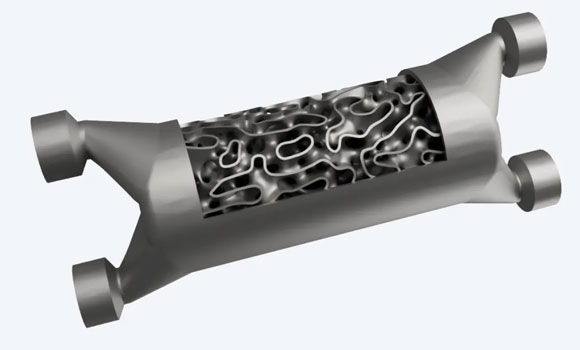
Spherene, based in Zürich, Switzerland, has announced the release of Spherene V3, offering advanced geometry controls and a new flow-optimised Adaptive Density Minimal Surfaces (ADMS) geometry that continuously adapts its cell size and thickness across a part. V3 expands the functional capabilities of ADMS for mechanical, thermal, and fluid applications.

Scatter Vector
Engineers can now define vector fields to locally influence ADMS geometry. This feature allows controlled anisotropy by stretching the geometry in specified directions, while preserving the continuous structure.
Flow ADMS
A new ADMS geometry type specifically designed for fluid applications. Flow ADMS addresses two common challenges in minimal-surface structures: unbalanced flow resistance between dual chambers and overall fluid resistance. Using an energy-optimised geometry, Flow ADMS is intended to achieve balanced pressure drop and reduced resistance, enabling more efficient fluid movement with minimal pumping energy.
Flow Direction
Building on Flow ADMS, this feature enables engineers to define preferred flow paths through vector fields. The geometry adapts to the user-defined flow directions, further reducing fluid resistance. In CFD simulations of heat exchangers, applying Flow Direction reportedly demonstrated approximately 20% lower pressure drop than equivalent gyroid-filled structures at comparable thermal performance.

Applications and Proof of Concept
These advancements enable application-specific implementations such as SphereneHEX, where the evolved ADMS geometry is used for controlled internal flow and heat dissipation within a single, additively manufacturable structure. SphereneHEX serves as a demonstration of how V3’s new geometry capabilities can directly improve thermal efficiency, flow control, and size reduction in next-generation engineering designs.
“SphereneV3 empowers users with full control over geometric anisotropy and enables the generation of flow-adapted ADMS, unlocking significant potential for fluid applications” Dr Jian Tang, Computational Engineer at Spherene and member of the Spherene V3 core development team.