Space Machines Company develops dual-metal rocket thruster using AM
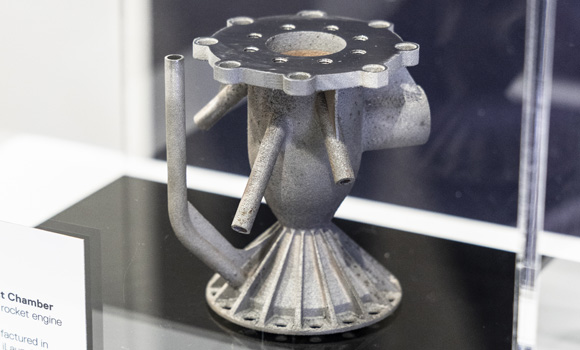
Space Machines Company (SMC), based in Botany, Australia, has produced a bi-metal rocket thruster using multi-material Additive Manufacturing. The company produced the thruster at CSIRO’s Lab22 using an SLM280 2MA Laser Beam Powder Bed Fusion (PBF-LB) machine from Nikon SLM Solutions.
Funded through the iLAuNCH Trailblazer programme, the thruster will power SMC’s Optimus Viper, an Australian-made spacecraft designed for on-orbit inspection, servicing and logistics.
Using Nikon SLM Solutions’ PBF-LB Additive Manufacturing technology, SMC was able to combine high-strength steel for structural strength as the thruster’s outer jacket and a copper alloy for high thermal activity. This combination reportedly allows the thruster to endure extreme heat while remaining lightweight and robust, something atypical in conventional, single-metal rocket propulsion systems.
“We strive to build sovereign space capabilities by developing, manufacturing and operating space technology right here in Australia,” said Darin Lovett, Executive Director of iLAuNCH. “We’re proud to support a project that demonstrates how Australian-led innovation is building world-class space technology and capability locally.”

Traditional methods for manufacturing rocket thrust chambers involve machining cooling channels into a copper liner and brazing it to a steel jacket, a costly, time-intensive process with multiple failure points. With multi-material Additive Manufacturing, both metals are manufactured simultaneously, reducing production complexity, cost and time while increasing design flexibility and durability.
“Space Machines Company is rapidly scaling production of our Optimus Viper vehicles to deliver persistent proximity operations and space domain awareness at unprecedented speed and scale,” said Rajat Kulshrestha, CEO, Space Machines Company. “By modifying our Scintilla thruster design to incorporate dual materials, we’ve gained the ability to rapidly experiment and optimise different material combinations, critical for achieving the propulsion performance of our mass-produced spacecraft.”
The thruster forms a key part of Space Machine’s Scintilla propulsion system, which requires precise, repeatable and durable thrust to carry out close proximity operations in orbit. The regenerative cooling provided by the copper alloy channels enables the thruster to withstand repeated firings and long burn durations, while the steel jacket maintains structural integrity under pressure.
“This achievement showcases the potential of multi-material Additive Manufacturing for complex, high-performance parts,” added CSIRO Senior Research Scientist Dr Cherry Chen. “By placing each material exactly where it’s needed, we can improve functionality, reduce waste and open up new design possibilities for a wide range of industries.”
CSIRO has stated that multi-material PBF-LB Additive Manufacturing has broader applications across sectors such as automotive, biomedicine, injection moulding, toolmaking, and heat exchanger manufacturing.