RMIT creates cheaper, stronger AM titanium alloy
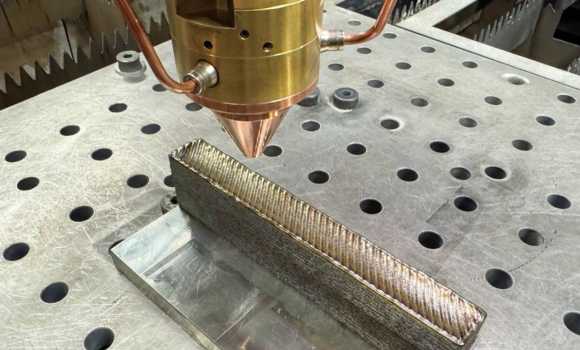
Engineers from RMIT University, Melbourne, Australia, have produced a new type of titanium alloy for Additive Manufacturing that is reportedly about a third cheaper than commonly used alternatives by using readily available and cheaper alternative materials to replace the increasingly expensive vanadium.
RMIT has filed a provisional patent on the approach, outlined in Nature Communications. The team is considering commercial opportunities to develop the new low-cost approach for the aerospace and medical device industries.
RMIT’s Centre for Additive Manufacturing (RCAM) PhD candidate and study lead author Ryan Brooke said that, upon testing, the alloy showed improved strength and performance compared to standard additively manufactured titanium alloys such as Ti-6Al-4V.
Brooke, who has recently accepted a Research Translation Fellowship at RMIT to investigate the next steps of commercialising the technology, shared, “3D printing allows faster, less wasteful and more tailorable production yet we’re still relying on legacy alloys like Ti-6Al-4V that doesn’t allow full capitalisation of this potential. It’s like we’ve created an aeroplane and are still just driving it around the streets.”

“New types of titanium and other alloys will allow us to really push the boundaries of what’s possible with 3D printing and the framework for designing new alloys outlined in our study is a significant step in that direction,” Brooke continued.
The latest study outlines a time- and cost-saving method to select elements for alloying, to take advantage of emerging Additive Manufacturing technology.
This work provides a clearer framework for predicting the additively manufactured grain structure of metallic alloys in AM. Through this design framework, alloys can be also manufactured more evenly, eliminating the formation of columnar microstructures that lead to uneven mechanical properties in some materials.
“By developing a more cost-effective formula that avoids this columnar microstructure, we have solved two key challenges preventing widespread adoption of 3D printing,” said Brooke, who recently completed market validation as part of CSIRO’s ON Prime programme, talking with representatives from the aerospace, automotive, and MedTech sectors. “What I heard loud and clear from end users was that to bring new alloys to market, the benefits have to not just be minor incremental steps but a full leap forward, and that’s what we have achieved here.”
“We have been able to not only produce titanium alloys with a uniform grain structure, but with reduced costs, while also making it stronger and more ductile,” Brooke added.
Study corresponding author Professor Mark Easton said RCAM was focused on creating new collaborations to further develop the technology, “We are very excited about the prospects of this new alloy, but it requires a team from across the supply chain to make it successful. So, we are looking for partners to provide guidance for the next stages of development.”
The full paper is available here.
www.rmit.edu.au