Researchers create 3D thermal cloak using metal AM
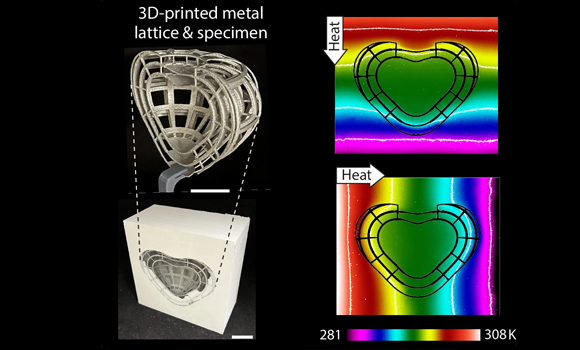
Researchers at the University of Illinois Urbana-Champaign, USA, and the Technical University of Denmark (DTU) have used metal Additive Manufacturing to fabricate what they describe as the first experimentally validated omnidirectional three-dimensional thermal cloak capable of concealing arbitrarily complex objects from thermal detection while maintaining a stable internal temperature.
Reported in Nature Communications, the research realises the long-predicted theory of transformation thermotics using a graded AlSi10Mg lattice produced by metal Additive Manufacturing. The work demonstrates how architected metallic structures can precisely control heat flow around complex three-dimensional objects.

Rather than blocking heat, the thermal metamaterial redirects it around an object, leaving the external temperature field almost unchanged. Infrared imaging therefore perceives the cloaked region as though no object is present, while the enclosed object remains insulated from external thermal extremes.
The research was led by Professor Shelly Zhang, postdoctoral researcher Weichen Li and graduate student Yibo Wang from the University of Illinois Urbana-Champaign, in collaboration with Professor Ole Sigmund of DTU.
“A real thermal cloak should work no matter where the heat comes from,” Zhang said. “Our device can hide a complex 3D object in an infinite number of directions while keeping the temperature inside stable and protected.”
The team developed a lattice composite with independently tunable thermal conductivity in three orthogonal directions. By varying the cross-sectional dimensions of mutually perpendicular lattice members, they tailored the local conductivity tensor required for transformation thermotics.
According to the researchers, the lattice occupies much of the theoretically achievable thermal conductivity property space while remaining manufacturable by Additive Manufacturing. The design combines numerical homogenisation with a three-dimensional de-homogenisation process, enabling graded lattice structures to be mapped onto complex free-form geometries while preserving the required anisotropic heat transport.

To validate the concept, the researchers additively manufactured the lattice in AlSi10Mg before infiltrating it with low-conductivity PDMS silicone and embedding it within a thermally conductive background. Testing under controlled temperature gradients showed heat flowing around the cloaked region while leaving the surrounding temperature field largely undisturbed. At the same time, the protected region maintained a comparatively uniform temperature.
The team also demonstrated cloaks for increasingly complex geometries, including heart-shaped components and a human face represented using spherical harmonic modelling. One example concealed an apple within the thermal signature of a pear, illustrating the flexibility of the computational design approach.
Unlike many previous demonstrations limited to simple analytical shapes, the proposed workflow enables cloaks to be designed directly for highly complex free-form geometries. The authors state that combining transformation thermotics with spherical harmonic representations produces cloaks with “record-breaking complexity.”
The researchers also assessed practical engineering considerations, including different core and background materials, internal heat generation, manufacturing tolerances, interfacial thermal resistance and transient thermal behaviour relevant to industrial deployment. Potential applications include thermal management for high-power electronics, protecting sensitive components in extreme thermal environments and reducing infrared detectability for defence and security applications.
“Any field that needs precise control of heat or needs to protect something from being detected thermally could benefit from this work,” Zhang explained. “But we also see it more broadly: it’s about hiding and protecting information that is carried by heat.”
The research was supported by the US National Science Foundation, the Villum Foundation and the Air Force Office of Scientific Research. Zhang is also affiliated with the Department of Mechanical Science and Engineering and the National Center for Supercomputing Applications at the University of Illinois Urbana-Champaign.
The full paper is available here.