POSTECH improves metal–polymer bonding in Additive Manufacturing
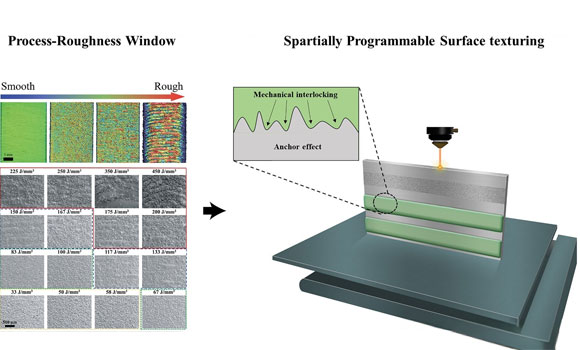
Schematic of the proposed spatially programmable surface texturing for metal-polymer bonding and its workflow (Courtesy Taylor & Francis)

Researchers from the Pohang University of Science and Technology (POSTECH), South Korea, have published research in Virtual and Physical Prototyping on a Laser Beam Powder Bed Fusion (PBF-LB) technique that engineers surface roughness to improve bonding strength between additively manufactured metal parts and silicone polymers.

EOS M4 ONYX: Exploring a customer-led path to scaling series metal Additive Manufacturing

The study explored how process parameter adjustments could be used to control the surface roughness of metal AM parts while maintaining relative densities above 99%. Researchers produced surfaces ranging from polished finishes with an average roughness (Ra) of 2.1 µm to as-built morphologies with Ra values of 26.7 µm, 56.9 µm and 65.9 µm.

The researchers then evaluated the surfaces for metal–polymer bonding performance using lap-shear tests with EcoFlex, Dragon Skin and polydimethylsiloxane (PDMS) silicone polymers. According to the findings, the engineered roughness significantly improved adhesion strength compared to polished surfaces.

The highest bonding performance was achieved using the high-roughness condition with an Ra of 56.9 µm. Under these conditions, adhesive strengths reached 220.8 kPa for EcoFlex, 321.0 kPa for Dragon Skin and 717.2 kPa for PDMS.

Compared to untreated polished surfaces, the approach increased adhesive strength by 214.3% for EcoFlex, 228.5% for Dragon Skin and 228.7% for PDMS, the researchers reported.

Steel reinvented: Colnago’s Steelnovo and the search for the perfect modern road bike

The researchers also demonstrated the fabrication of multi-roughness regions within a single component, which could enable site-specific functionality in hybrid metal–polymer Additive Manufacturing machines.

The researchers concluded that their manufacturing-integrated roughness engineering strategy could provide a simplified route to producing high-performance metal–polymer joints while supporting the development of design-flexible multi-material architectures.

‘Surface roughness engineering of mechanical interlocking for enhanced metal–polymer adhesion in additive manufacturing’ is available here.

www.postech.ac.kr

GET THIS ISSUE:  PDF  |  VIEW ONLINE  |  BUYER’S GUIDE

TRUSTED CONTENT. TARGETED AUDIENCE

Advertise with Metal AM and access a global base of 50,000+ AM professionals.

Contact Jon Craxford: [email protected]

Request a Media Pack
  • AM machines
  • Process monitoring & calibration
  • Heat treatment & sintering
  • HIP systems & services
  • Pre- & post-processing technology
  • Powders, powder production and analysis
  • Part manufacturers
  • Consulting, training & market data

Don’t miss a thing – register for our newsletter

Don't miss any new issue of Metal AM magazine, and get the latest industry news. Sign up to our twice weekly newsletter.

Register now

Join 40,000+ other AM professionals – follow us online

About Metal Additive Manufacturing magazine

Metal AM magazine, published quarterly in digital and print formats, is read by a rapidly expanding international audience.

Our audience includes component manufacturers, end-users, materials and equipment suppliers, analysts, researchers and more.

In addition to providing extensive industry news coverage, Metal AM magazine is known for exclusive, in-depth articles and technical reports.

Our focus is the entire metal AM process from design to application.

Each issue is available as an easy-to-navigate digital edition and a high-quality print publication.

Discover our magazine archive…

The free to access Metal Additive Manufacturing magazine archive offers unparalleled insight into the world of metal Additive Manufacturing from a commercial and technological perspective through:

  • Reports on visits to leading metal AM part manufacturers and industry suppliers
  • Articles on technology and application trends
  • Information on materials developments
  • Reviews of key technical presentations from the international conference circuit
  • International industry news

All past issues are available to download as free PDFs or view in your browser.

Browse the archive

Share via
Copy link
Powered by Social Snap