Phoenix Scientific Industries explores CVD route for ODS alloys

Phoenix Scientific Industries (PSI), based in Hailsham, United Kingdom, has highlighted what it describes as a newer and increasingly promising approach for producing oxygen dispersion strengthened (ODS) alloys. While traditionally produced through mechanical alloying, the alternative method involves coating metal powder particles in a fluidised bed reactor using chemical vapour deposition (CVD). This method enables precise control over oxide distribution and opens new pathways for next-generation materials, such as GRX-810.
ODS alloys are a class of high-performance metallic materials engineered to retain strength and stability under extreme conditions. Their performance is attributed not only to composition, but also to a carefully engineered nanoscale microstructure. ODS alloys are typically based on nickel, iron, or cobalt, strengthened by a fine, stable dispersion of oxide particles (commonly yttria, Y₂O₃), usually 5 – 50 nm in size.
PSI stated that creep is a major failure mode in engineering materials. ODS alloys can resist this slow deformation under stress at high temperatures because dislocation motion is hindered, grain boundary sliding becomes suppressed, and diffusion processes are slowed. This reportedly enables ODS alloys to operate at approximately 0.8–0.9 of their melting temperature, far beyond conventional alloys.
Production of ODS alloys
Historically, ODS alloys have been made by mechanical alloying, a Powder Metallurgy process involving high-energy ball-milling to mix together the metal powder and oxides. This has presented limitations including contamination from the milling media, difficulty in controlling dispersion at the nanoscale and high cost, as well as long processing times.
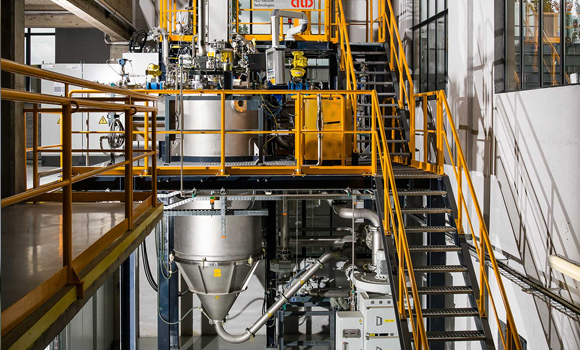
This is where newer methods, like fluidised bed CVD coating, come in, PSI stated. A fluidised bed reactor suspends fine metal powder particles in an upward-flowing gas stream, creating a fluid-like state. Instead of mixing oxides mechanically, each particle is coated with an oxide precursor. During consolidation, oxides form in situ.
Key advantages over mechanical alloying are said to include:
- More uniform dispersion – each particle is coated individually, ensuring consistent oxide distribution
- Tailored chemistry – precise control over oxide type, coating thickness and multi-layer or graded coatings
- Better reproducibility and scalability – fluidised bed reactors are already used industrially
- Compatibility with Additive Manufacturing – suitability of powders for Laser Beam Powder Bed Fusion (PBF-LB) and Directed Energy Deposition (DED)
- Reduced contamination – reduced risk of component failure due to contamination in the build
Fluidised bed CVD could offer a transformative approach to producing ODS alloys by enabling precise, scalable coating of individual powder particles. When combined with advanced consolidation techniques and AM, the company states that this method offers a powerful alternative to conventional mechanical alloying.
Materials like GRX-810 illustrate this potential. These alloys are not only stronger and more durable but also engineered at the nanoscale for extreme performance.
This approach of utilising CVD coatings in a fluidised bed reactor is reportedly being explored for advanced alloys like GRX-810 and other ODS alloys. This makes fluidised bed CVD a strong candidate for producing next-generation ODS powders tailored for AM.
‘A Route to Advanced ODS Alloys’ can be read here.